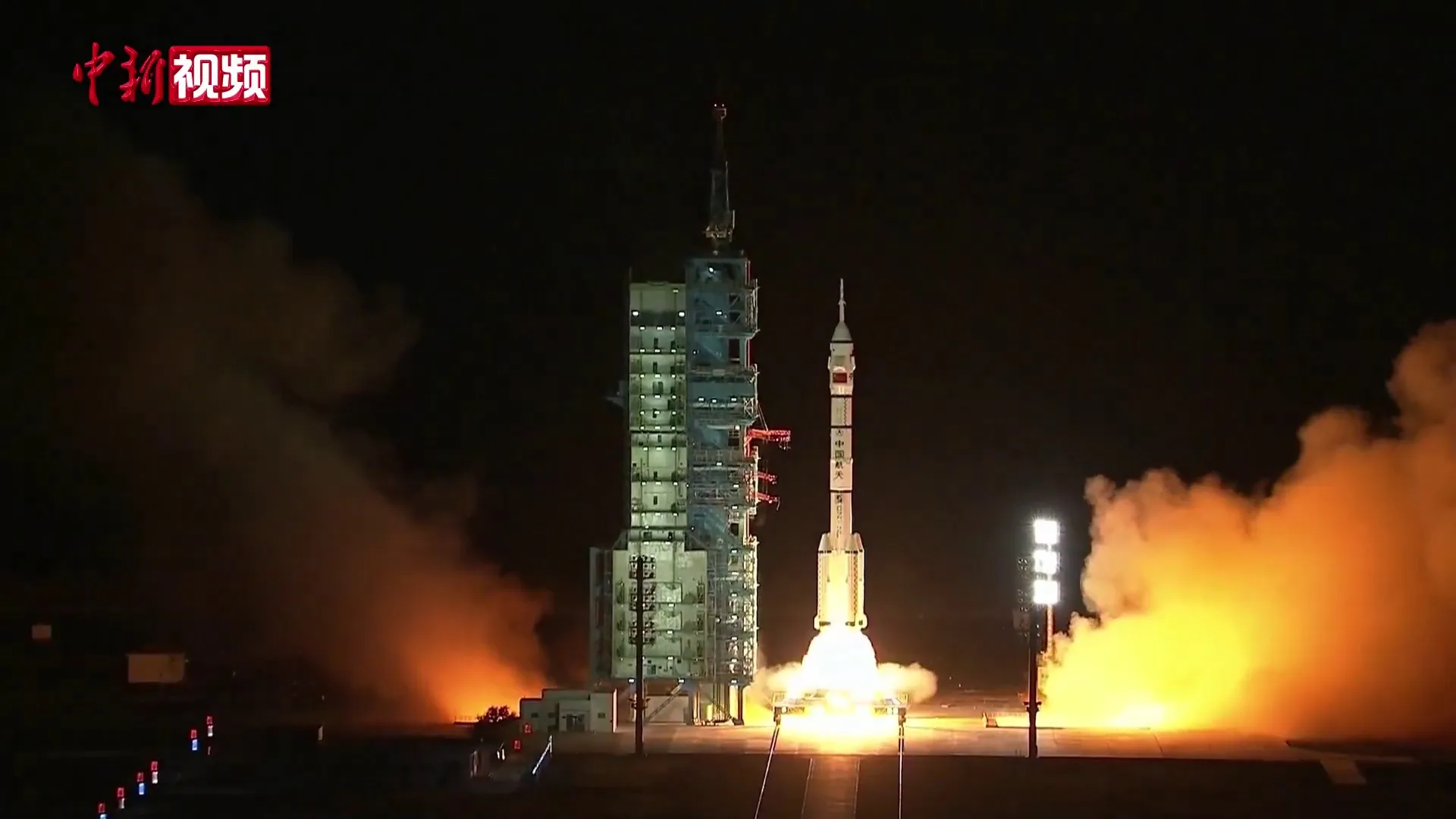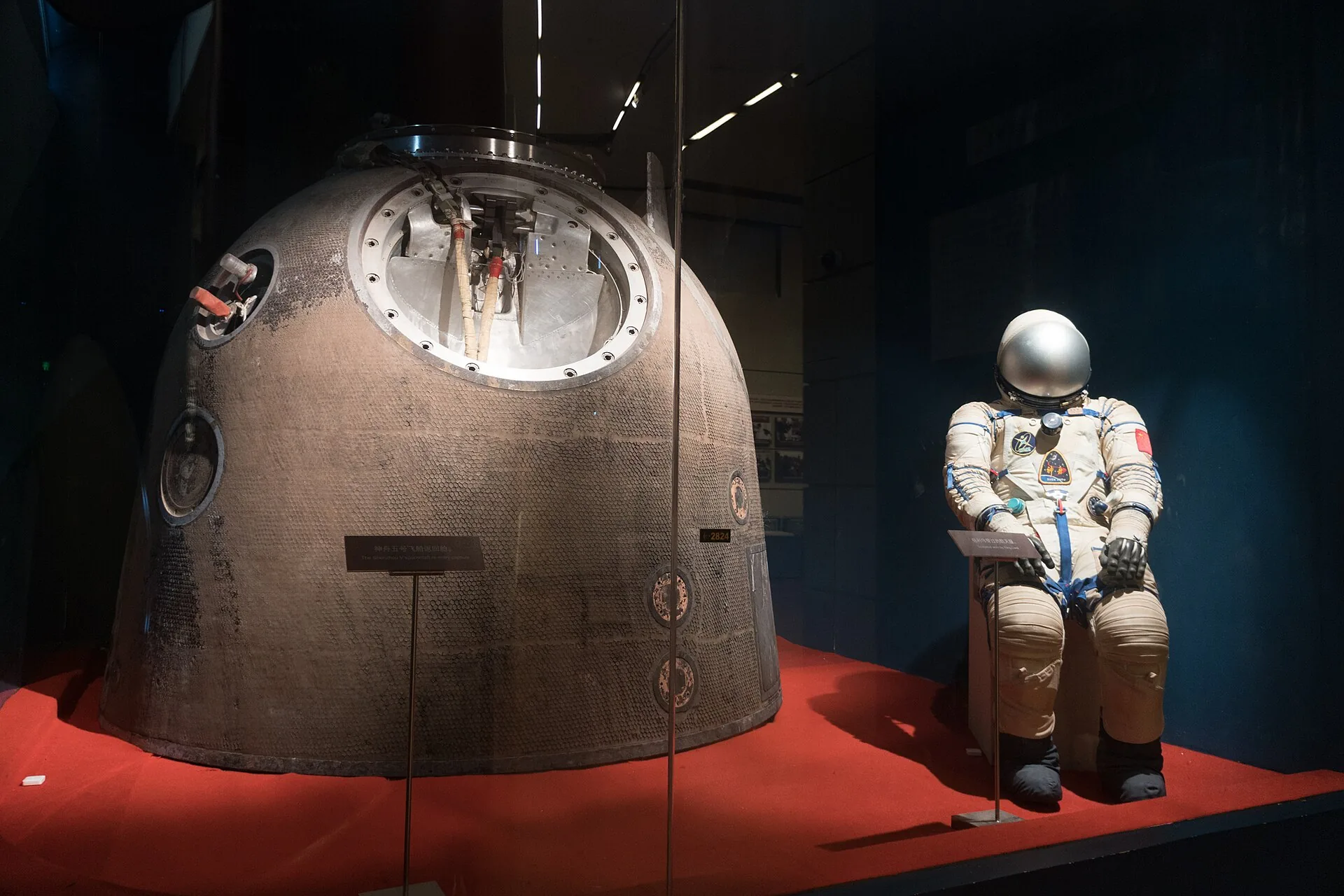
At 09:00 Beijing time on October 15, 2003, a 38-year-old fighter pilot named Yang Liwei sat strapped into a bell-shaped capsule on top of a Long March 2F rocket in the cold desert air of the Gobi. He carried a pistol, a knife, and a small Chinese flag. When the engines lit, the vibration grew so violent that, as he later admitted, "for a moment I thought I was going to die" — a pogo resonance so severe the instrument panel blurred into a smear of light. Then it passed. Twenty-one hours and fourteen orbits later, he stepped out of a scorched capsule on the grasslands of Inner Mongolia, and China had become only the third nation in history to launch a human being into orbit on its own hardware.
The spacecraft that carried him was called Shenzhou — "Divine Vessel." It is the throughline of one of the most disciplined national engineering campaigns of the modern era: a program that went from a single 21-hour flight to a permanently crewed space station in less than two decades, and that now stands on the threshold of the Moon. This is the story of Shenzhou and the taikonauts who fly it — the arc of Chinese human spaceflight, from a locked-away plan in 1992 to the crews circling overhead as you read this in the summer of 2026.
Project 921: A Plan Locked in a Vault
China had dreamed of putting a person in space long before it had the means. As early as 1971, a program called Project 714 selected 19 candidate pilots for a planned "Shuguang-1" capsule, only to see the effort dissolve into the chaos of the Cultural Revolution without a single flight. For two decades the ambition slept.
It reawakened on September 21, 1992, when President Jiang Zemin signed the authorization for Project 921. What made 921 remarkable was not its secrecy but its patience. It laid out a three-step roadmap spanning more than thirty years: first, put a taikonaut into low Earth orbit and return them safely; second, master spacewalking, rendezvous, and docking; and third, assemble and operate a permanent space station. It was an audacious multi-decade bet — and, almost uniquely among national space plans, China would hit each milestone within a year or two of the original schedule.
The word "taikonaut," now standard in English coverage, blends the Mandarin taikong ("space") with the Greek -naut. China's astronaut corps was drawn, in its first two batches, entirely from the elite ranks of People's Liberation Army Air Force test pilots.
Building the Divine Vessel
The vehicle at the center of Project 921 borrowed its silhouette, and a good deal of its philosophy, from the Soviet Soyuz. The family resemblance is obvious: a three-part architecture of an orbital module up front, a bell-shaped descent module in the middle where the crew rides through reentry, and a service module at the rear carrying propulsion and power.
But Shenzhou is not a Soyuz clone. It is noticeably larger and heavier — roughly eight tonnes at launch against Soyuz's seven — giving its crews more room and margin. Its most distinctive feature is the orbital module. On Soyuz, that module is jettisoned and discarded before reentry. On Shenzhou, it was designed to keep its own solar panels and stay in orbit as a free-flying satellite for months after the crew returned home, doubling as an autonomous science platform. In effect, every early Shenzhou flight left a small laboratory behind in orbit — a clever way to squeeze extra value from each expensive launch, and a sign that China intended Shenzhou to be more than a taxi.
Four uncrewed test flights, Shenzhou 1 through 4, flew between November 1999 and the end of 2002, wringing out the life-support, guidance, and reentry systems. Only when the engineers were satisfied did they put a human aboard.
Yang Liwei and the 21 Hours That Changed Everything
Shenzhou 5 carried a single man, and it was meant to. China took no chances on its first crewed flight, keeping the mission short and the crew size at one. Yang Liwei's 21-hour, 14-orbit journey on October 15–16, 2003 closed a gap of more than four decades: the Soviet Union had first launched a human in 1961, the United States in 1962, and no one else had managed it independently in the 41 years since. The difficulty of that feat is precisely what made China's achievement land so hard.
The mission was not flawless. The brutal launch vibration Yang endured was traced to a pogo-oscillation resonance between the rocket's core stage and the capsule around 26 seconds into flight, and engineers subsequently redesigned it out of the Long March 2F. But Yang came home a national hero, and China had proven the whole chain worked: rocket, capsule, life support, reentry, recovery. Step one of Project 921 was complete.
The milestones then came in a rapid, deliberate cadence. Shenzhou 6, in October 2005, carried two taikonauts — Fei Junlong and Nie Haisheng — for five days, testing the vehicle with a real working crew for the first time. Shenzhou 7, in September 2008, delivered the mission that step two had been building toward.
Spacewalks, Women in Orbit, and the First Space Labs
On September 27, 2008, taikonaut Zhai Zhigang squeezed out of the Shenzhou 7 orbital module and floated free in the vacuum, waving a small Chinese flag to a live television audience — China's first spacewalk, or extravehicular activity. The moment was choreographed to ride the wave of national pride cresting after the Beijing Olympics weeks earlier, but the engineering behind it was genuine: China had now demonstrated the pressure-suit and airlock capability that any station-building nation must have.
The next symbolic threshold fell in June 2012. Shenzhou 9 carried Major Liu Yang, a 33-year-old transport pilot with 1,680 flight hours, who became the first Chinese woman in space. A year later, Shenzhou 10's Wang Yaping delivered a live physics lecture from orbit to an estimated 60 million Chinese schoolchildren — plausibly the largest science class ever taught; she would return years later as the first Chinese woman to walk in space.
Those two missions also docked with China's first orbital outposts. Tiangong-1, a single-module prototype launched in September 2011, was the target for China's first crewed rendezvous and docking — the delicate ballet of two craft meeting at 28,000 kilometers per hour. (Its orbit later decayed, and it reentered harmlessly over the South Pacific in April 2018.) Tiangong-2, launched in September 2016, tested the long-duration life support, cargo resupply, and in-orbit propellant transfer a permanent station would demand. With that, step two of Project 921 was finished, and the third and largest step was ready to begin.
The Leap to Tiangong
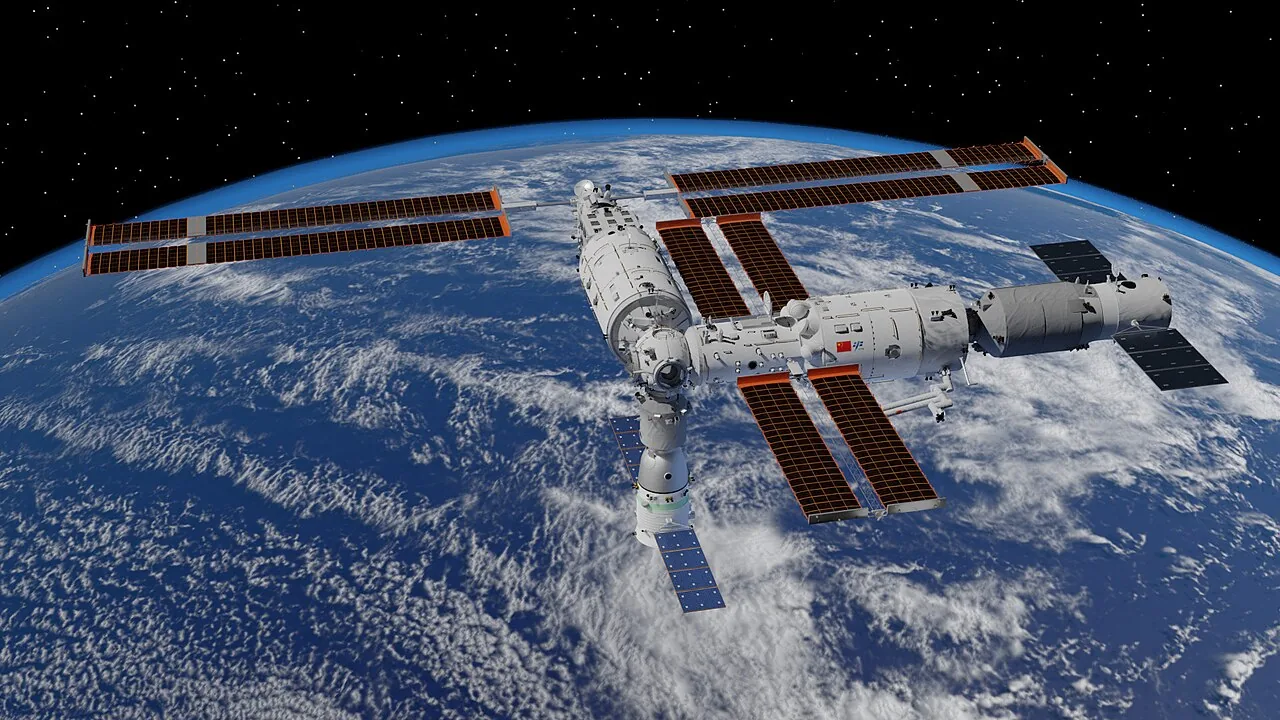
The permanent station, when it came, arrived fast. The Tianhe ("Harmony of Heaven") core module launched on April 29, 2021 — at 16.6 meters long and 22.5 tonnes, the largest spacecraft China had ever built. Over the following eighteen months, two laboratory modules joined it: Wentian in July 2022 and Mengtian in October 2022, completing the T-shaped, roughly 100-tonne Tiangong station. It is about a quarter the mass of the International Space Station, but it was never meant to match the ISS pound for pound — it was sized precisely for a crew of three on routine rotations, and six during handovers.
Continuous human occupation began with Shenzhou 12 in June 2021 and has not stopped since. Every mission afterward — Shenzhou 13, 14, 15, and onward — has delivered a fresh three-person crew on a roughly six-month cadence, the incoming and outgoing crews overlapping for about a week so the station is never empty. The corps that once flew a single taikonaut at a time was now rotating veterans and rookies through an orbital home in a rhythm indistinguishable from the seasoned ISS program. China had, quietly and on schedule, become a full-fledged station-operating nation.
The Crews of 2025–2026: A Real Test in Orbit
The most recent chapter of the Shenzhou story is also its most dramatic — a reminder that spaceflight remains unforgiving, and that a mature program is defined by how it handles trouble.
Shenzhou 20 launched on April 24, 2025, commanded by veteran Chen Dong with rookies Chen Zhongrui and Wang Jie. Shenzhou 21 followed on October 31, 2025, under commander Zhang Lu, flight engineer Wu Fei — who at 32 became the youngest Chinese taikonaut to fly — and payload specialist Zhang Hongzhang. Shenzhou 21 also carried four mice, China's first study of mammals in orbit; one female gave birth to nine healthy pups aboard the station in December 2025, evidence that a short spaceflight does not wreck mammalian reproduction.
Then the trouble came. In early November 2025, just hours before the Shenzhou 20 crew was to head home, taikonauts found a small triangular crack in the outer pane of their descent capsule's window — attributed to a suspected debris strike. Rather than risk a compromised reentry, China made an extraordinary call: the Shenzhou 20 crew came home aboard the newer, freshly docked Shenzhou 21 spacecraft instead. That left the Shenzhou 21 crew without a lifeboat, so on November 25, 2025, China launched an uncrewed Shenzhou 22 to serve as their return vehicle. The Shenzhou 21 crew finished a full six-month tour — logging three spacewalks totaling nearly 21 hours, one an eight-hour inspection of the wounded ship — and handed the station to the arriving Shenzhou 23 crew before returning on May 29, 2026. The damaged Shenzhou 20 capsule was later brought back uncrewed.
The current residents, Shenzhou 23, launched on May 24, 2026 under commander Zhu Yangzhu with pilot Zhang Zhiyuan and payload specialist Lai Ka-ying — the first person from Hong Kong to fly in space, and one of three crew members slated for a stay approaching a full year, among the longest single spaceflights ever attempted. The episode was messy, expensive, and public. It was also a display of exactly the kind of flexible, keep-the-crew-safe improvisation that separates an experimental program from an operational one.
Mengzhou, Lanyue, and the Road to the Moon
Shenzhou has served brilliantly, but it was built for low Earth orbit, and China's ambitions have outgrown it. The successor is Mengzhou ("Dream Vessel"), a next-generation crew spacecraft that looks less like Soyuz and more like NASA's Orion or SpaceX's Dragon — a partially reusable capsule with a detachable heat shield. It comes in two variants: a low-orbit version that can carry six or seven taikonauts to Tiangong, and a lunar version, more heavily radiation-hardened and built to survive the searing high-speed reentry of a return from the Moon.
Mengzhou is no longer a paper spacecraft. On February 11, 2026, China conducted a maximum-dynamic-pressure abort test, firing the launch-escape system to yank a Mengzhou capsule clear of its rocket about 65 seconds into flight, at an altitude near 11 kilometers; both the crew module and the booster stage were recovered. It was a crucial safety milestone for a vehicle meant to carry humans beyond Earth orbit.
The lunar architecture around it is taking shape in parallel. Two super-heavy Long March 10 rockets will fly separately — one lofting a crewed Mengzhou, the other an uncrewed Lanyue ("Embracing the Moon") lander — to rendezvous in lunar orbit. Two taikonauts will transfer into Lanyue, descend to the surface, explore, and ride the lander back up to the waiting Mengzhou for the trip home. China ran liftoff-and-landing tests of the Lanyue lander in August 2025 and continues to push toward an uncrewed dress rehearsal late this decade, with the goal of putting Chinese astronauts on the lunar surface by 2030. If the schedule holds, the same program that flew a single taikonaut for 21 hours in 2003 will have reached the Moon in a single human generation.
The Measure of a Program
There is a temptation, in the West, to frame Chinese human spaceflight as imitation — Soyuz heritage, an ISS-style station, an Apollo-style Moon shot. But that framing misses what is genuinely striking about the Shenzhou arc: its steadiness. Where other programs lurched between cancellation and revival, Project 921 published a thirty-year plan in 1992 and then, milestone by milestone, executed it. From Yang Liwei's flight to continuous Tiangong occupation took just eighteen years — the fastest transition from spacefaring nation to space power ever made.
The window crack of 2025 and the Mengzhou abort test of 2026 belong to the same story as the flag Zhai Zhigang waved in 2008 and the pistol Yang Liwei carried in 2003 — checkpoints on a road that runs, deliberately, from a locked plan in a Beijing vault to two taikonauts stepping onto the Moon before the decade is out. The Divine Vessel got them off the ground. The Dream Vessel is meant to take them the rest of the way.