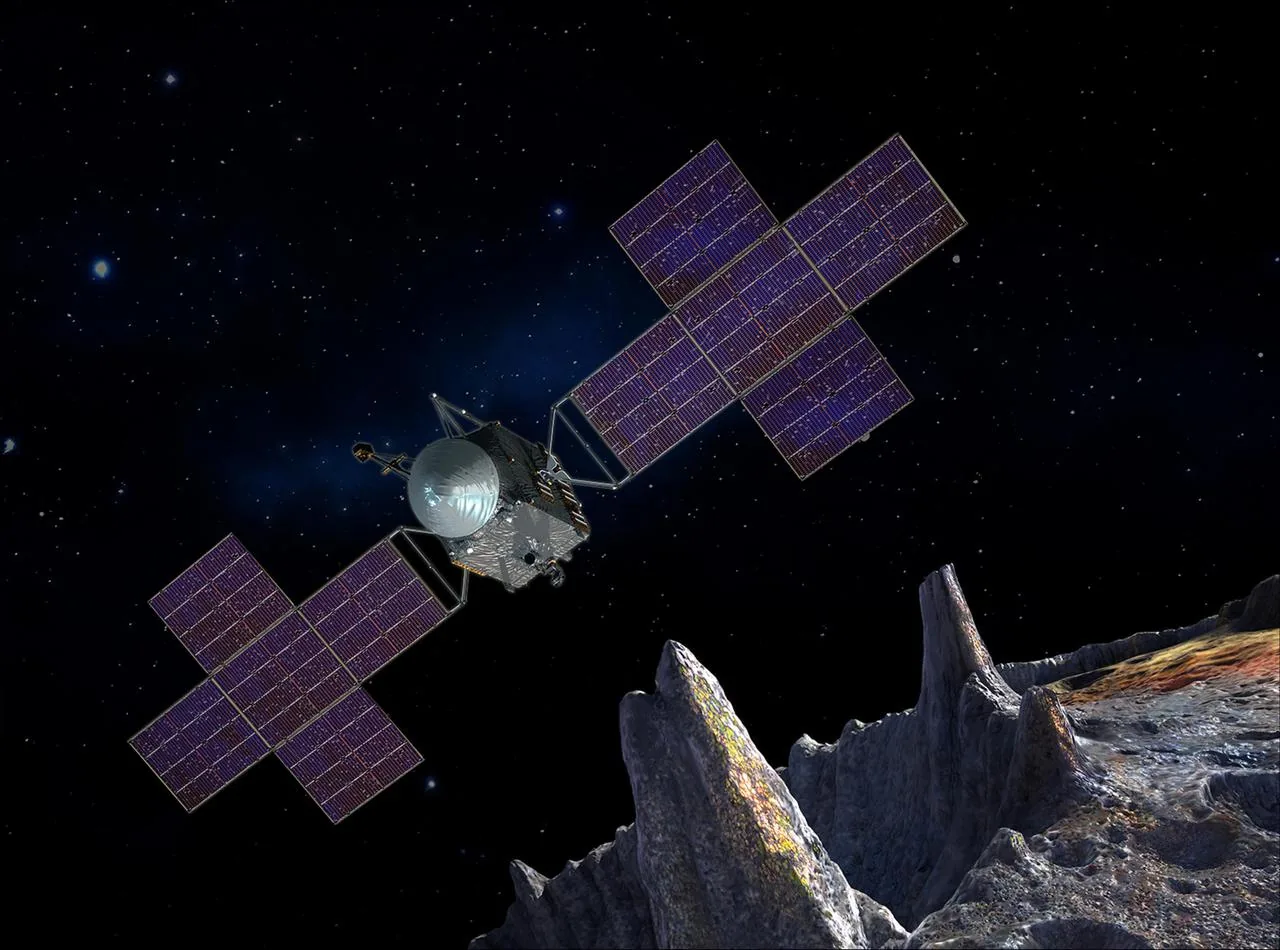
On October 16, 2021, an Atlas V rocket climbed away from Cape Canaveral Space Force Station carrying a spacecraft on one of the most ambitious trajectories ever planned. Over the next twelve years, NASA's Lucy mission will visit eight asteroids across two different swarms, covering roughly 6.3 billion kilometers and swinging past Earth three times for gravity assists. No spacecraft has ever attempted anything like it. The targets are Jupiter's Trojan asteroids, ancient remnants of the solar system's earliest days that have been trapped in gravitational dead zones for over four billion years. Scientists call them fossils of planet formation. If you want to understand how the solar system came together, the Trojans are where you look.
Lucy is not heading to a single destination. It is threading a needle through the inner solar system and out to Jupiter's orbit and back again, visiting a diverse collection of primitive bodies that have never been explored up close. Each flyby will provide a snapshot of a different type of small body, and together they will paint the most complete picture yet of the raw materials from which the planets were built.
What Are the Trojan Asteroids?
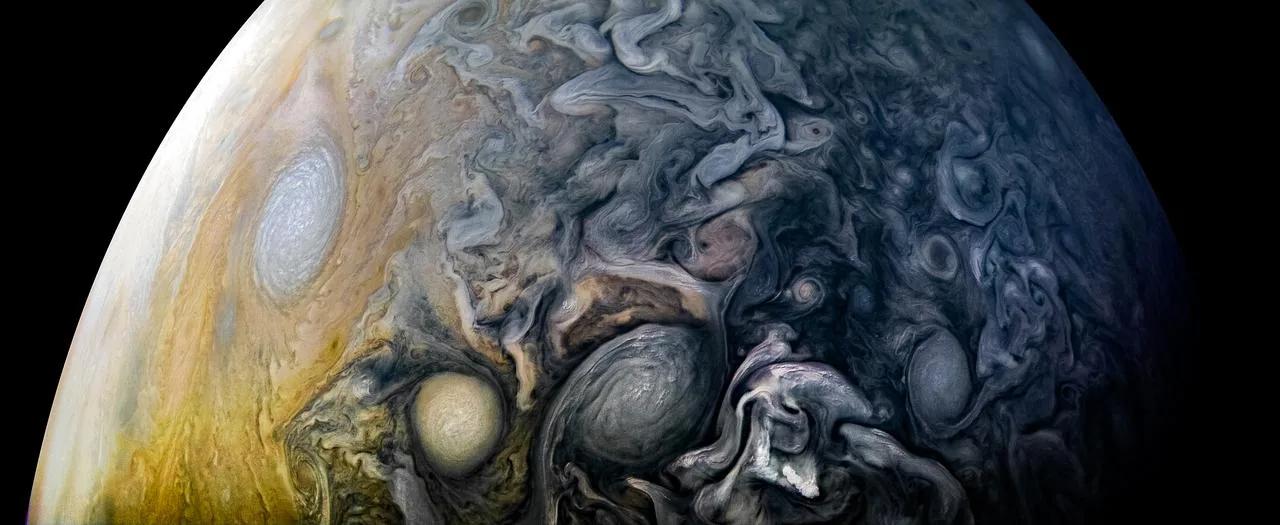
To understand why the Trojans matter, you need to understand where they live and how they got there. Jupiter, by far the most massive planet in the solar system at 318 times Earth's mass, creates two gravitational sweet spots along its orbit around the Sun. These are the L4 and L5 Lagrange points, stable equilibrium zones located 60 degrees ahead of and 60 degrees behind Jupiter in its orbital path. Objects that drift into these regions become trapped, oscillating gently around the Lagrange points in a gravitational balance between Jupiter and the Sun. They have been there for billions of years.
The L4 swarm, which leads Jupiter in its orbit, is sometimes called the Greek camp. The L5 swarm, trailing Jupiter, is called the Trojan camp. Together, they contain more than 12,000 known objects, and the total population may exceed one million asteroids larger than one kilometer in diameter. That makes the Trojan swarms among the largest populations of small bodies in the solar system outside the asteroid belt and the Kuiper Belt.
What makes the Trojans scientifically extraordinary is their age and diversity. These are not the relatively processed rocks of the inner asteroid belt. The Trojans are believed to have been captured into their current positions during a period of dramatic planetary migration early in the solar system's history, roughly 4 to 4.5 billion years ago. According to the Nice model and its successors, the giant planets did not form where they are today. Jupiter, Saturn, Uranus, and Neptune migrated through the outer solar system, scattering and reshuffling enormous populations of small bodies. The Trojans are survivors of that chaotic era, samples of material from different formation regions that ended up locked in Jupiter's gravitational embrace.
Because they have been stored at roughly 5.2 astronomical units from the Sun ever since, in a cold, stable environment far from the intense heating and collisional processing of the inner solar system, the Trojans preserve a chemical and physical record of conditions in the early solar system that has been lost almost everywhere else. They are, in the most literal sense, fossils of planet formation.
The Lucy Mission: An Overview
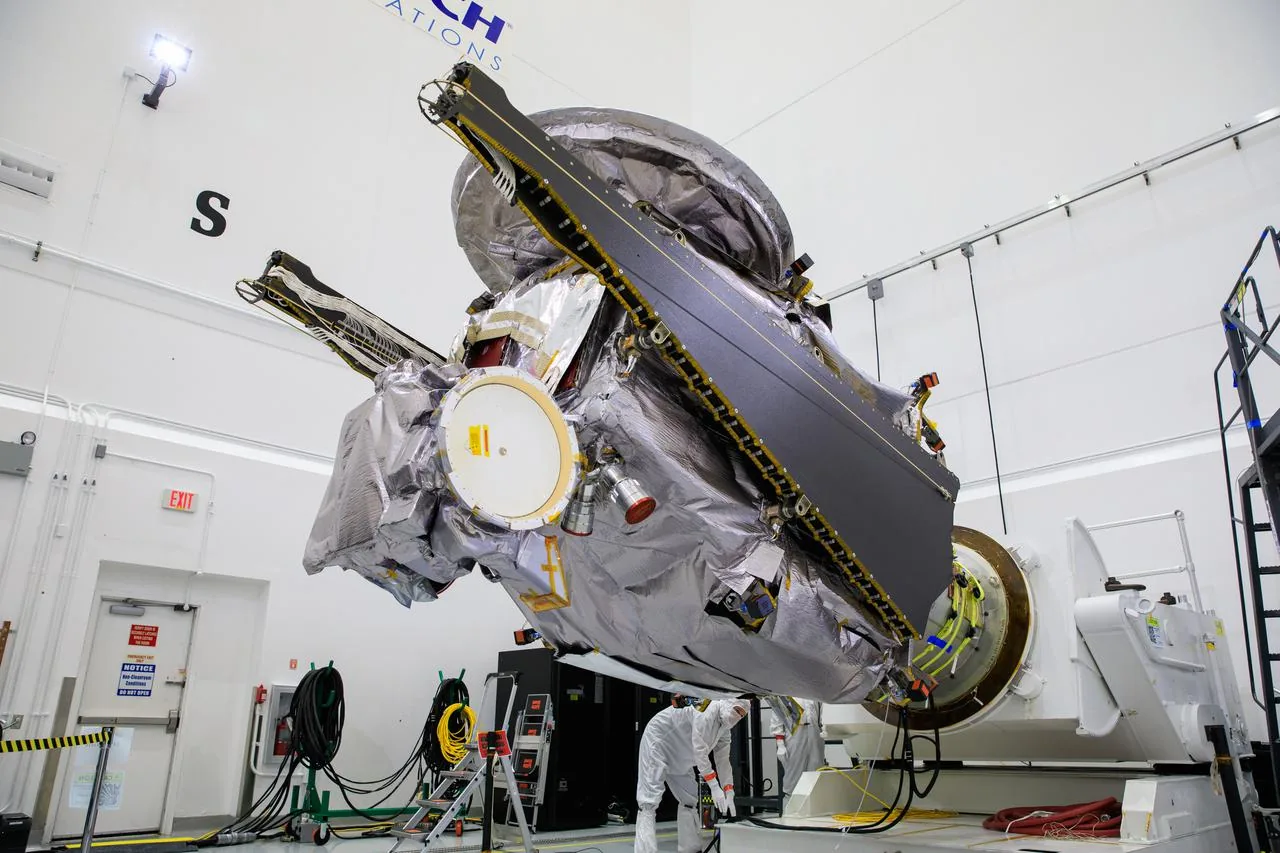
Lucy is a NASA Discovery-class mission, meaning it was competitively selected under a cost-capped program that emphasizes focused science goals and innovative mission design. The principal investigator is Hal Levison of the Southwest Research Institute (SwRI) in Boulder, Colorado, one of the architects of the Nice model of planetary migration. Lockheed Martin Space built the spacecraft at its facility near Denver.
The mission's total cost is approximately $981 million, a figure that covers the spacecraft, its instruments, the launch vehicle, and twelve years of operations. For that investment, NASA gets close encounters with more individual targets than any previous planetary mission. Lucy will fly past a total of eight asteroids: one in the inner main belt, five in the L4 Trojan swarm, and a binary pair in the L5 swarm.
Lucy carries three primary science instruments. L'Ralph is an infrared spectrometer and color imager derived from the Ralph instrument on New Horizons that mapped Pluto. It will measure surface composition, identifying ices, organics, and minerals on each target. L'LORRI (Lucy LOng Range Reconnaissance Imager) is a high-resolution panchromatic camera that will provide detailed surface imaging, revealing craters, boulders, fractures, and other geological features. L'TES (Lucy Thermal Emission Spectrometer) will measure thermal infrared radiation to determine surface properties such as thermal inertia, which reveals whether a surface is bare rock, fine regolith, or something in between.
The spacecraft also carries a terminal tracking camera system for autonomous navigation during the high-speed flybys, and a high-gain antenna for communication with Earth across distances that will exceed 850 million kilometers.
A Trajectory Like No Other
Lucy's flight path is an engineering masterpiece. To reach both the L4 and L5 Trojan swarms with a single spacecraft, mission designers devised a complex series of loops through the inner solar system, using Earth's gravity to reshape the orbit at each pass.
The sequence is as follows. After launch in October 2021, Lucy swung back past Earth for its first gravity assist on October 16, 2022, exactly one year after launch. It then headed outward to the inner main asteroid belt for its first science target. A second Earth gravity assist on December 12, 2024, bent the trajectory toward the L4 Trojan swarm. The L4 encounters will take place in 2027 and 2028. After completing those flybys, Lucy will loop back to Earth for a third gravity assist in 2030, which will redirect it across the solar system to the L5 swarm for a final encounter in 2033.
The total flight path covers approximately 6.3 billion kilometers. At each flyby, Lucy will pass its targets at relative velocities of roughly 6 to 9 kilometers per second, with closest approach distances planned at around 1,000 kilometers or less. The encounter windows are brief, typically just a few hours of prime science around closest approach, which places enormous demands on the spacecraft's autonomous navigation and instrument pointing systems.
One of the mission's most impressive technical achievements is that Lucy is entirely solar-powered. At Jupiter's distance from the Sun, solar intensity is only about 3.7 percent of what it is at Earth. Lucy's two circular solar arrays, each nearly 7.3 meters in diameter, are among the largest ever deployed on a planetary spacecraft. Together, they provide roughly 500 watts of power at the Trojan swarms, enough to run all instruments and the spacecraft's systems.
The Dinkinesh Flyby: A Stunning Surprise
Lucy's first science target was not a Trojan at all. On November 1, 2023, the spacecraft flew past Dinkinesh, a small inner main belt asteroid roughly 790 meters across, at a distance of approximately 431 kilometers. The flyby was added to the mission primarily as an engineering checkout, a chance to test the spacecraft's terminal tracking system and instrument suite before the more distant and higher-stakes Trojan encounters.
What happened next stunned the science team. As Lucy's images resolved Dinkinesh during approach, it became clear that this tiny asteroid was not alone. Orbiting Dinkinesh was a small moon, and that moon turned out to be a contact binary, two objects fused together in a shape resembling a rubber duck or a peanut. The team named the moon Selam, an Ethiopian word meaning "peace," chosen to complement Dinkinesh, which means "you are marvelous" in Amharic and is also the Ethiopian name for the Lucy fossil.
Selam measures roughly 220 meters along its longest axis and consists of two lobes approximately 210 and 150 meters across that are pressed together. This makes the Dinkinesh system a remarkable triple configuration: a primary asteroid with a contact-binary satellite. Such systems had been theorized but never directly observed in this configuration before.
The discovery provided immediate scientific value. The formation of contact binaries and asteroid satellites is thought to be driven by the YORP effect, in which asymmetric thermal radiation from sunlight gradually spins up small asteroids until they shed material or fission. Dinkinesh and Selam offer a natural laboratory for studying these processes. The team also identified a trough or ridge feature on Dinkinesh's surface that may be related to the satellite's formation, suggesting that the primary was structurally affected when material was shed to create Selam.
The Dinkinesh flyby also validated Lucy's critical terminal tracking navigation system, confirming that the spacecraft can autonomously track and point its instruments at a small, fast-moving target during a high-speed encounter. That capability is essential for the Trojan flybys, where failure would mean missing a target that took years to reach.
Donaldjohanson: A Main Belt Waypoint
On April 20, 2025, Lucy flew past its second target, the inner main belt asteroid 52246 Donaldjohanson, named after paleoanthropologist Donald Johanson, who discovered the Lucy fossil in Ethiopia in 1974. Donaldjohanson is a small C-type (carbonaceous) asteroid approximately 4 kilometers in diameter, a member of the Erigone collisional family in the inner main belt.
The Donaldjohanson encounter served as the final dress rehearsal before the Trojan flybys. It tested the full instrument suite and navigation system against a slightly larger and more scientifically interesting target than Dinkinesh. As a C-type asteroid, Donaldjohanson's dark, carbon-rich surface represents a class of primitive material that may share compositional similarities with some of the Trojans. The data from this flyby provides a valuable comparison point that will help scientists interpret what they see at the Trojans.
This encounter also occurred during the phase of the mission where the second Earth gravity assist, completed in December 2024, had already set Lucy on course for the L4 swarm. Donaldjohanson was a target of opportunity along that trajectory.
The L4 Trojan Swarm: Four Targets in 2027-2028
The heart of the Lucy mission begins in August 2027, when the spacecraft reaches the L4 Trojan swarm leading Jupiter. Over roughly fifteen months, Lucy will fly past four separate targets in this swarm, each representing a different type of Trojan.
Eurybates and Queta (August 12, 2027): Eurybates is a roughly 64-kilometer-diameter C-type asteroid and the largest remnant of an ancient collisional family within the L4 swarm. Studying a collisional family member reveals what is inside a larger parent body that was shattered long ago, providing a look at the interior composition of a primitive Trojan. Eurybates also has a small satellite, Queta, approximately 1.2 kilometers in diameter, discovered in 2020 using the Hubble Space Telescope. The Eurybates-Queta system will allow the team to determine the asteroid's mass and density, critical measurements for understanding internal structure.
Polymele (September 15, 2027): Polymele is a small P-type asteroid roughly 21 kilometers in diameter. P-type asteroids are among the most primitive objects in the solar system, with very dark surfaces that may be rich in organic compounds. In a preview of Lucy's talent for surprises, ground-based stellar occultation observations in March 2022 revealed that Polymele also has a satellite, roughly 5 kilometers in diameter, orbiting at a distance of about 200 kilometers. This discovery means Lucy will visit yet another binary system.
Leucus (April 18, 2028): Leucus is a D-type asteroid approximately 40 kilometers in diameter with an unusually slow rotation period of roughly 446 hours, nearly 19 Earth days. This extremely slow spin is a puzzle. Most asteroids of this size rotate in 5 to 15 hours. Understanding why Leucus rotates so slowly may reveal information about its collisional history, internal structure, or the effects of thermal forces over billions of years. Leucus also has a very elongated shape, making it a particularly interesting target for imaging.
Orus (November 11, 2028): Orus is a D-type asteroid roughly 51 kilometers in diameter. D-type asteroids are the most common type among the Trojans and are thought to have formed in the outer solar system, possibly beyond Neptune's current orbit, before being captured during planetary migration. Orus will serve as a representative example of this dominant population, providing a baseline for understanding the bulk composition and surface properties of typical Trojans.
The diversity of these four targets is deliberate. By visiting C-type, P-type, and D-type asteroids, along with both solitary bodies and binary systems, Lucy will sample the full range of Trojan compositions and physical states. This comparative approach is far more powerful than visiting a single target.
Patroclus-Menoetius: The Grand Finale in 2033
After completing the L4 encounters, Lucy will swing back to Earth for its third gravity assist in 2030, then cross the solar system to reach the L5 Trojan swarm trailing Jupiter. On March 2, 2033, Lucy will fly past its final and arguably most scientifically valuable target: the Patroclus-Menoetius binary system.
Patroclus and Menoetius are a nearly equal-mass binary pair, each roughly 113 and 104 kilometers in diameter, orbiting their common center of mass at a separation of about 680 kilometers with a period of approximately 4.3 days. This makes them one of the most remarkable binary systems in the solar system. Nearly equal-mass binaries are thought to be primordial, meaning they likely formed together during the early solar system rather than through later collisions or tidal disruption. If this is confirmed, Patroclus-Menoetius would be a direct, largely unmodified relic from the era of planet formation.
The binary nature of the system also means Lucy can determine the total mass precisely from orbital mechanics, and combined with volume measurements from imaging, calculate the density. The expected density of these bodies is low, possibly close to that of water ice, which would confirm that they are porous, volatile-rich objects from the outer solar system rather than dense rocky bodies.
Patroclus-Menoetius is the only target in the L5 swarm, but its scientific value is immense. It represents a class of object that may be the most pristine surviving material from the solar system's formation.
What Lucy Will Teach Us
The Lucy mission addresses some of the most fundamental questions in planetary science. How did the planets form? What was the original distribution of material in the solar system? How did the giant planets migrate, and what happened to the small bodies that were scattered during that process?
The Trojans are the key because they represent a population that was collected from different parts of the solar system and then preserved in cold storage. Their diversity in color, composition, size, and satellite systems suggests they did not all form in the same place. Some may have originated in the region between Jupiter and Saturn. Others may have come from beyond Neptune. By characterizing their surfaces, compositions, densities, and structures, Lucy will test models of planetary migration and determine where these objects came from.
The mission also addresses the connection between Trojans and other small body populations. The Trojans share spectral similarities with comets, Kuiper Belt objects, and certain types of outer main belt asteroids. Understanding whether these resemblances reflect shared origins or convergent evolution of surfaces will help scientists build a coherent picture of the small body populations across the solar system.
On a practical level, Lucy's measurements of density and internal structure will reveal whether the Trojans are solid, rubble-pile, or highly porous bodies. This information matters not only for science but for future considerations of planetary defense and resource utilization. Understanding how primitive bodies are put together is essential for predicting how they might respond to deflection attempts.
Named for a Fossil, Studying Fossils
The name Lucy carries a double meaning that perfectly captures the mission's scientific purpose. The spacecraft is named after the 3.2-million-year-old fossilized skeleton of a female Australopithecus afarensis, discovered by Donald Johanson and Tom Gray in the Afar region of Ethiopia on November 24, 1974. That fossil, in turn, was nicknamed Lucy by the expedition team because the Beatles' song "Lucy in the Sky with Diamonds" was playing at their camp that evening.
The Lucy fossil revolutionized our understanding of human evolution, providing critical evidence that bipedal walking preceded the evolution of large brains. NASA's Lucy spacecraft aims to achieve an analogous revolution in our understanding of the solar system's early history. Just as the fossil Lucy revealed secrets about our origins as a species, the spacecraft Lucy is designed to reveal secrets about the origins of our planetary system.
The naming tradition extends throughout the mission. The asteroid Dinkinesh carries the Ethiopian name for the Lucy fossil. The moon Selam is named for a 3.3-million-year-old fossil child of the same species, discovered in 2000 in the Dikika region of Ethiopia. The asteroid Donaldjohanson honors the paleontologist who found the original fossil. Even the mission's logo incorporates a diamond shape, a nod to the song that inspired it all.
Lucy's Legacy
As of early 2026, Lucy is healthy and on course, having successfully completed its Dinkinesh and Donaldjohanson flybys and its critical Earth gravity assists. The spacecraft's instruments are performing well, and the navigation system has been proven in flight. The first Trojan encounters are now less than eighteen months away.
When Lucy reaches the Trojans in 2027, it will open an entirely new chapter in solar system exploration. No spacecraft has ever visited these objects. No telescope, no matter how powerful, can reveal the surface geology, composition, and physical properties that a close flyby can measure. Each of Lucy's targets has been chosen to represent a different piece of the puzzle, and together they will provide the first comprehensive survey of the most ancient, most diverse, and least understood population of small bodies in the solar system.
The mission embodies a principle that drives all of planetary science: to understand where we are, we must understand where we came from. The Trojan asteroids are time capsules from the solar system's turbulent youth, scattered across Jupiter's orbit like fragments of a story waiting to be read. Lucy is going to read them.