Somewhere between Mars and Jupiter, drifting quietly in the asteroid belt, there is an object unlike anything we have ever visited. It is not made of rock and ice like most asteroids. It is not a rubble pile held together by weak gravity. Asteroid 16 Psyche appears to be made largely of metal -- iron, nickel, and perhaps other metallic elements -- and it may be the exposed core of a failed planet, a world that was stripped of its rocky mantle billions of years ago and left naked in space.
NASA's Psyche spacecraft launched on October 13, 2023, and is now on its way to find out. When it arrives in 2029, it will give us our first close-up look at a metallic world, opening a window into the hidden interiors of rocky planets that we can never directly access on Earth, Mars, or any other differentiated body.
This is one of the most scientifically unique missions NASA has ever flown. Let me explain why.
What Is 16 Psyche?
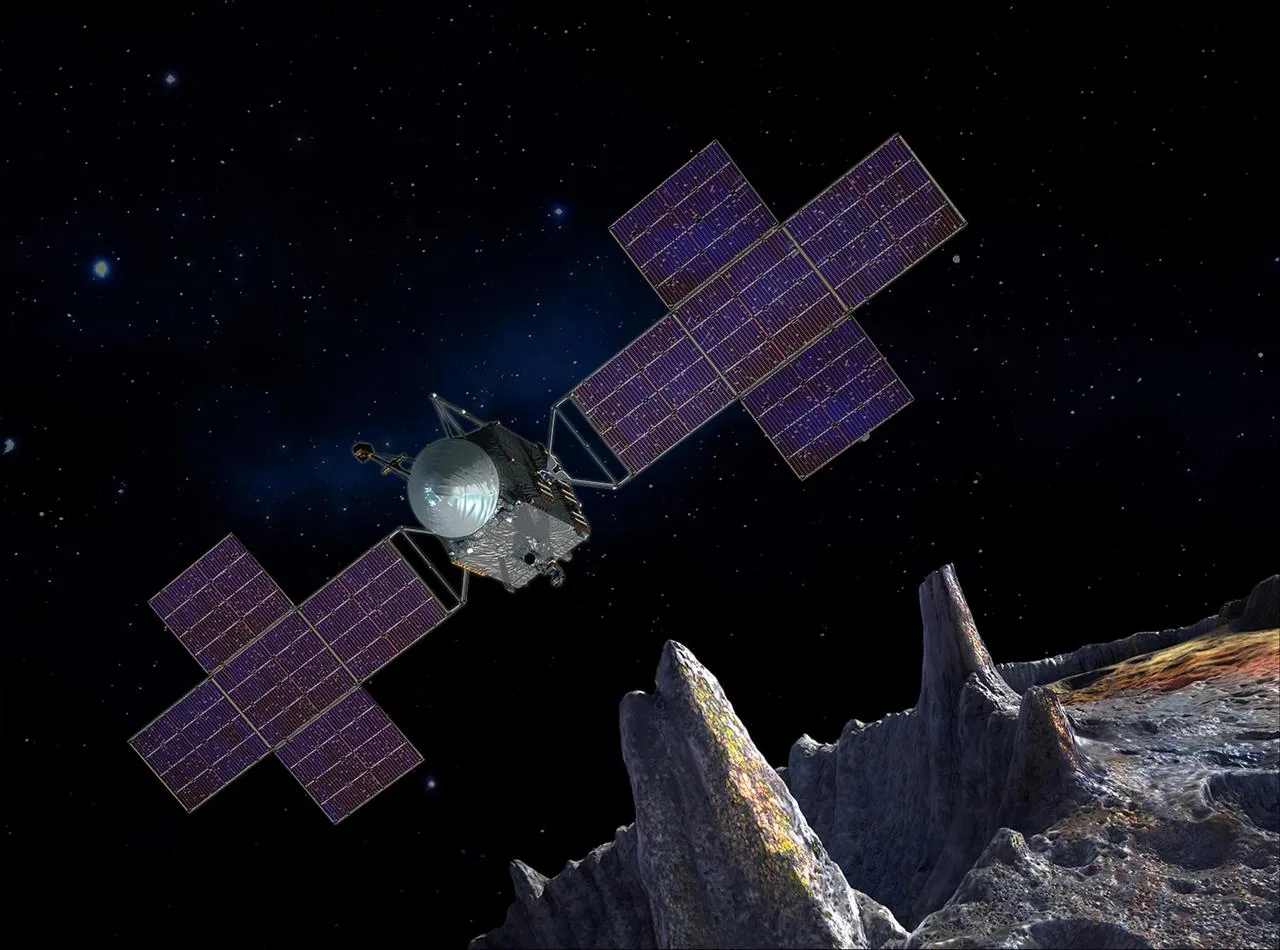
Discovered in 1852 by Italian astronomer Annibale de Gasparis, 16 Psyche is one of the largest objects in the asteroid belt, roughly 280 kilometers by 232 kilometers by 164 kilometers -- potato-shaped, as so many asteroids are. It orbits the Sun at an average distance of about 3 astronomical units, completing one orbit every five Earth years.
What makes Psyche special is its composition. Ground-based radar observations and spectral studies have long indicated that Psyche has an unusually high metal content. Its radar reflectivity is much higher than typical rocky asteroids, consistent with a surface dominated by iron-nickel metal. Its density, estimated at 3.4 to 4.1 grams per cubic centimeter, is higher than most stony asteroids but lower than pure iron, suggesting a mixture of metal and rock.
The leading hypothesis is that Psyche is the remnant core of a protoplanet -- a body that was large enough to differentiate, meaning its interior separated into a dense metallic core surrounded by a rocky mantle, much like Earth did early in its history. Something then stripped away the rocky outer layers, perhaps a series of massive collisions during the violent early days of the solar system. What remained was the core, exposed and preserved for billions of years.
If this is true, then Psyche offers something extraordinary: a chance to study a planetary core directly. Earth's core lies more than 2,900 kilometers beneath our feet, far beyond the reach of any drill. We study it only indirectly, through seismic waves and magnetic field observations. Psyche could let us see and measure what a core actually looks like.
The $10 Quintillion Myth
You may have seen headlines claiming that Psyche is worth $10 quintillion -- a number so absurd it makes the entire global economy look like pocket change. This figure is based on a simple (and silly) calculation: estimate the amount of iron and nickel in Psyche, multiply by the current market price per kilogram, and voila -- you get a number that makes great clickbait.
Let me debunk this right now. That valuation is meaningless for several reasons. First, we do not actually know Psyche's precise composition. It is likely a mixture of metal and rock, not a solid block of refined metal. Second, even if Psyche were pure iron-nickel, bringing that quantity of metal to Earth's market would catastrophically crash commodity prices -- the value only exists in a hypothetical world where supply has no effect on price. Third, we have no technology remotely capable of mining an asteroid in the belt and returning the material to Earth at any economically viable cost.
The Psyche mission is not about mining. It is not about getting rich from space resources. It is about understanding planetary formation, and that scientific knowledge is genuinely priceless in a way that no dollar figure can capture.
Solar Electric Propulsion: Getting There on Sunlight
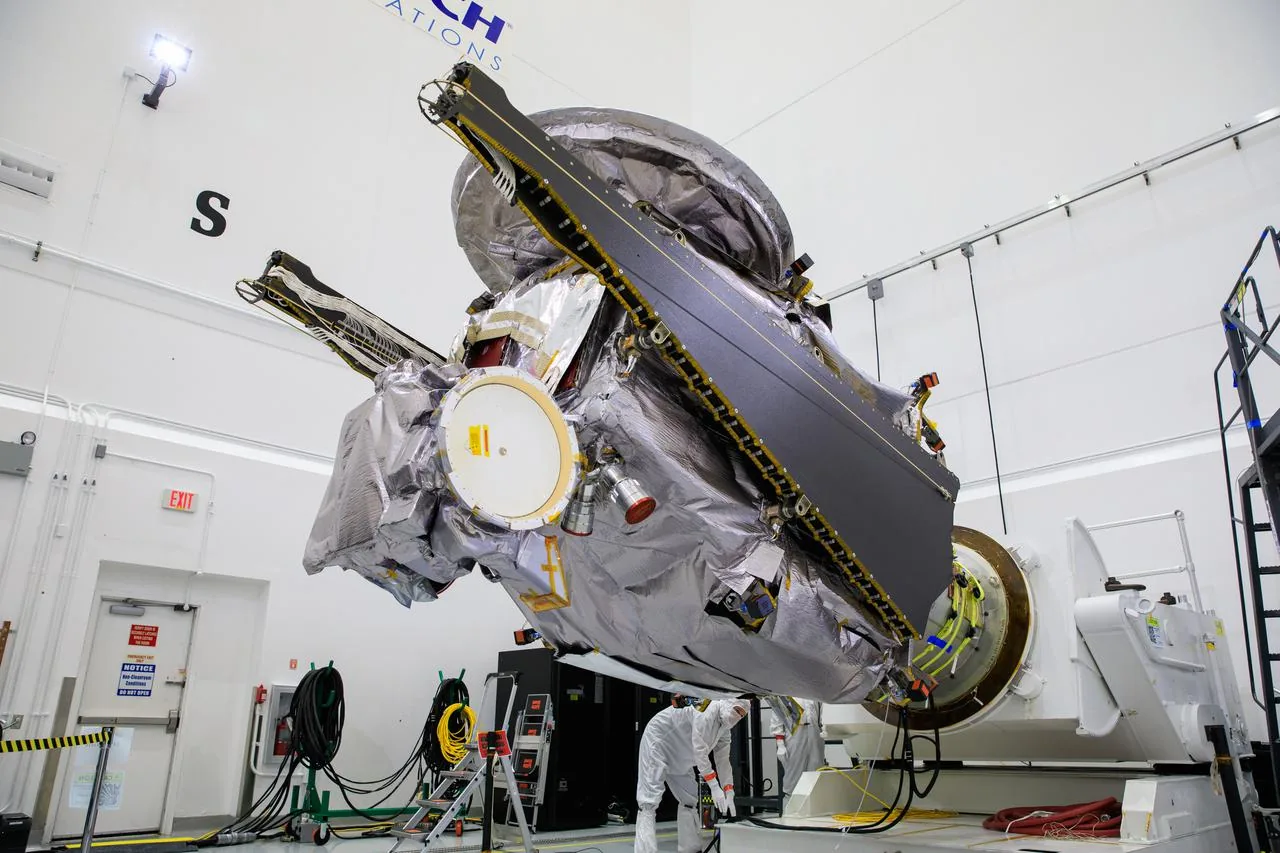
The Psyche spacecraft is powered by one of the most elegant propulsion systems ever flown in deep space: solar electric propulsion using Hall-effect thrusters. These thrusters work by ionizing xenon gas and accelerating the ions using an electric field, producing a gentle but incredibly efficient thrust.
How gentle? Each of Psyche's thrusters produces about the same force as holding three quarters in your hand -- roughly the weight of a few coins pressing on your palm. That is nothing compared to a chemical rocket. But here is the advantage: Hall-effect thrusters can fire continuously for months or even years, gradually building up speed. Over the course of the mission, Psyche will use about 922 kilograms of xenon propellant to accumulate a velocity change far greater than what a comparable mass of chemical propellant could provide.
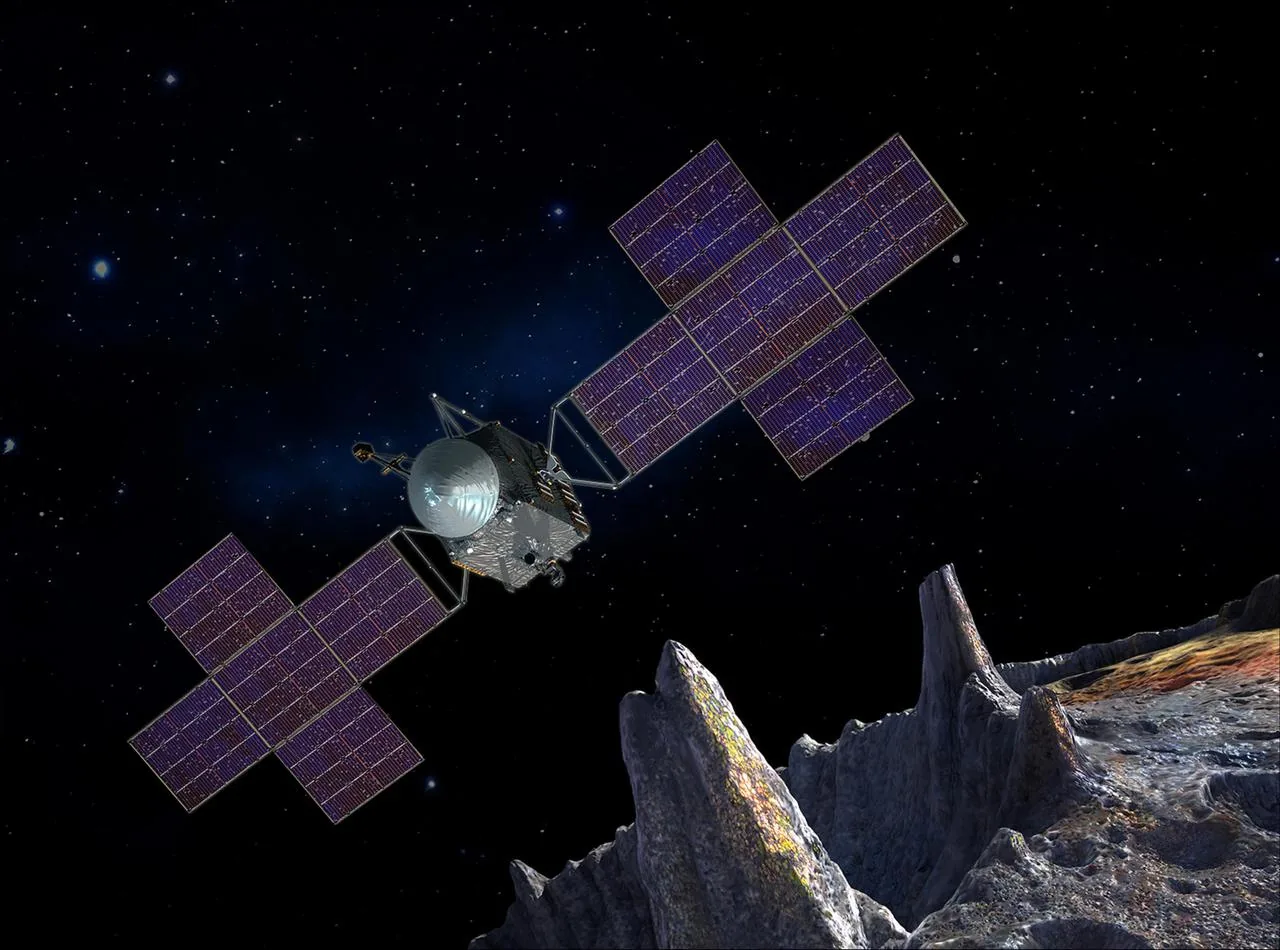
The spacecraft carries the largest solar arrays ever flown on a deep-space mission, spanning about 75 square meters -- roughly the size of a singles tennis court. Even at Psyche's distance from the Sun, where sunlight is significantly weaker than near Earth, these arrays generate enough electricity to power the thrusters and all the scientific instruments.
Solar electric propulsion is not new -- NASA's Dawn mission used ion thrusters to visit Vesta and Ceres -- but Psyche represents a significant step up in capability. The success of this propulsion system will inform the design of future deep-space missions, potentially making the outer solar system more accessible.
The Science: What Psyche Will Actually Do
The Psyche spacecraft carries three primary science instruments, plus a technology demonstration experiment.
The Multispectral Imager consists of a pair of cameras equipped with filters that will photograph Psyche's surface in multiple wavelengths. These images will reveal the asteroid's geology, topography, and surface composition in detail. Scientists will look for evidence of ancient volcanic or tectonic activity, impact craters, and variations in metal and silicate distribution across the surface.
The Gamma-Ray and Neutron Spectrometer will detect gamma rays and neutrons emitted by Psyche's surface when it is bombarded by cosmic rays. Different elements produce different signatures, allowing scientists to map the elemental composition of the surface and determine the relative proportions of iron, nickel, silicon, oxygen, and other elements.
The Magnetometer will search for a remnant magnetic field. If Psyche is indeed an ancient planetary core, it might retain traces of the magnetic dynamo that once operated when its metallic interior was still molten. Detecting a remnant field would be strong evidence for the exposed core hypothesis.
Additionally, the mission includes a technology demonstration called Deep Space Optical Communications (DSOC), which tested laser-based communication between the spacecraft and Earth during the early phase of the mission. DSOC successfully demonstrated data transmission rates far higher than traditional radio communication, paving the way for future missions that need to send large volumes of data from deep space.
The Big Questions
When Psyche arrives at the asteroid in 2029, it will spend approximately 26 months in orbit, gradually lowering its altitude to get increasingly close to the surface. The science team hopes to answer several fundamental questions.
Is Psyche truly an exposed planetary core, or is it something else entirely -- perhaps a body that formed from metallic material without ever being part of a larger differentiated world? The distinction matters enormously for our understanding of how the building blocks of planets assembled in the early solar system.
What does the surface of a metallic world look like? We have never seen one up close. Will there be metal cliffs, metallic lava flows, iron volcanoes? Or will the surface be more subdued, weathered by billions of years of micrometeorite bombardment into a featureless metallic regolith?
How did Psyche lose its mantle, if it ever had one? Was it stripped by a single catastrophic collision, or was the mantle removed gradually through multiple impacts? The crater record on Psyche's surface may hold clues.
And what can Psyche tell us about Earth's own core? If Psyche's composition and structure match our models of planetary cores, it validates our understanding of Earth's deep interior. If they do not match, we may need to rethink some fundamental assumptions.
Why This Mission Matters
Every world we visit for the first time teaches us something we did not expect. This has been the consistent lesson of planetary exploration, from the volcanoes of Io to the geysers of Enceladus to the methane lakes of Titan. Nobody predicted those discoveries before we arrived.
Psyche is the first metallic world humanity will ever explore. We genuinely do not know what we will find, and that uncertainty is what makes this mission so exciting. The asteroid has been sitting in the belt for 4.5 billion years, quietly holding secrets about how planets form, how they differentiate, and what their deepest interiors are made of.
In 2029, we finally get to ask it directly. And whatever the answers are, they will change how we think about the worlds beneath our feet and the processes that built them.