There is no career on Earth -- or off it -- quite like being an astronaut. Every two or three years, when NASA opens its astronaut application window, tens of thousands of highly qualified people throw their hats into the ring for a handful of spots. The 2021 class saw over 18,300 applicants competing for just 10 selections. Those are longer odds than getting into Harvard, making the NFL, or landing a record deal. But people do get selected, and the paths they take to get there are more varied than you might think.
If you have ever looked up at the night sky and wondered whether you could be one of the people who leaves this planet behind, even temporarily, here is what it actually takes in 2026.
Astronaut Selection by Agency (2026)
| Agency | Most Recent Class | Applicants | Selected | Education Required | Other Requirements | Pay |
|---|---|---|---|---|---|---|
| NASA (USA) | 2024 ("Flies") class | ~12,000 (2020 cycle) | 10 | MS in STEM (or test pilot 1,000+ hrs) | US citizenship, 2 yrs related experience or 1,000 hrs PIC jet, swim test, vision correctable to 20/20 | GS-13/15: $114K–$185K |
| ESA | 2022 class (selected from 22,500 applicants) | ~22,500 | 5 career + 11 reserve + 1 parastronaut | MS in natural sciences/eng/medicine; pilot OK | ESA member-state nationality, fluent English, ages 27–37 typical | ~€7K/month base + flight pay |
| Roscosmos (Russia) | 2021 cohort | ~1,500 | 4 | Bachelor's, Russian citizen | Age <35, military pilot or eng, height 150–190 cm | ~$50–70K USD equivalent |
| JAXA (Japan) | 2023 class | 4,127 | 2 | Bachelor's STEM, 3 yrs experience | Japanese citizen, English working level | |
| CNSA (China) | Group 4 (2023) | Several thousand | 14 | Mostly PLA pilots; Group 4 first civilians | Chinese citizen, military background preferred (not always required Group 4+) | Classified |
| ISRO (India) | Gaganyaan candidates (2020) | ~12 IAF test pilots screened | 4 (3 flying + 1 backup) | Engineering degree, IAF/Navy test pilot | Indian citizen, military test pilot | IAF rank pay |
| CSA (Canada) | 2017 class | 3,772 | 2 | Bachelor's STEM/medicine | Canadian citizen, English+French preferred | C$104K–194K |
| UAE | 2021 class | 4,305 | 2 | Bachelor's, English, Arabic | UAE national | Private compensation |
| Private (commercial) | Polaris Dawn, Inspiration4, Axiom Ax-1/2/3/4 | Self-funded or sponsored | Per mission | Varies (no formal floor) | Mission-specific health/training | Self-paid (~$55M per Crew Dragon seat) |
Caveat: Selection cycles are infrequent (every 4–8 years per agency). Acceptance rates < 0.1%. Most successful candidates apply 2–3 times. Current ISS-class missions accept up to age 65; private missions are more flexible.
The NASA Route: America's Gold Standard
NASA remains the most well-known pathway to space, and their requirements are surprisingly straightforward on paper. To be eligible, you need United States citizenship plus one of the following:
- A master's degree in a STEM field (engineering, biological science, physical science, computer science, or mathematics) from an accredited institution
- A Doctor of Medicine (M.D.) or Doctor of Osteopathic Medicine (D.O.) degree
- Completion of a nationally recognized test pilot school program
- A doctorate (Ph.D.) in a STEM field
In lieu of a master's degree, NASA also accepts two years of work toward a doctoral program in a related STEM field, a completed Doctor of Medicine or Doctor of Osteopathic Medicine degree, or two years of professionally related experience after a bachelor's degree. That last option is huge -- it means that if you have a bachelor's in engineering and spend two years working at a company like SpaceX or Boeing, you meet the educational threshold.
On top of education, you need at least two years of related, progressively responsible professional experience OR at least 1,000 hours of pilot-in-command time in jet aircraft. That pilot requirement is why so many astronauts come from military test pilot backgrounds -- it is one of the most direct ways to accumulate those flight hours.
Physical requirements are strict but not superhuman. You need 20/20 vision (correctable with surgery -- LASIK is now accepted), blood pressure no higher than 140/90 in a sitting position, and a height between 62 and 75 inches. You must pass the NASA long-duration spaceflight physical, which is roughly equivalent to a military flight physical.
The Selection Numbers Game
Here is the reality check. NASA's 2021 Astronaut Candidate Class (the "Turtle" class) selected 10 individuals from those 18,300+ applicants. That is an acceptance rate of about 0.05%. The 2017 class selected 12 from over 18,000. The people who make it are not just qualified -- they are extraordinary. Most have multiple advanced degrees, extensive field experience, and often military service.
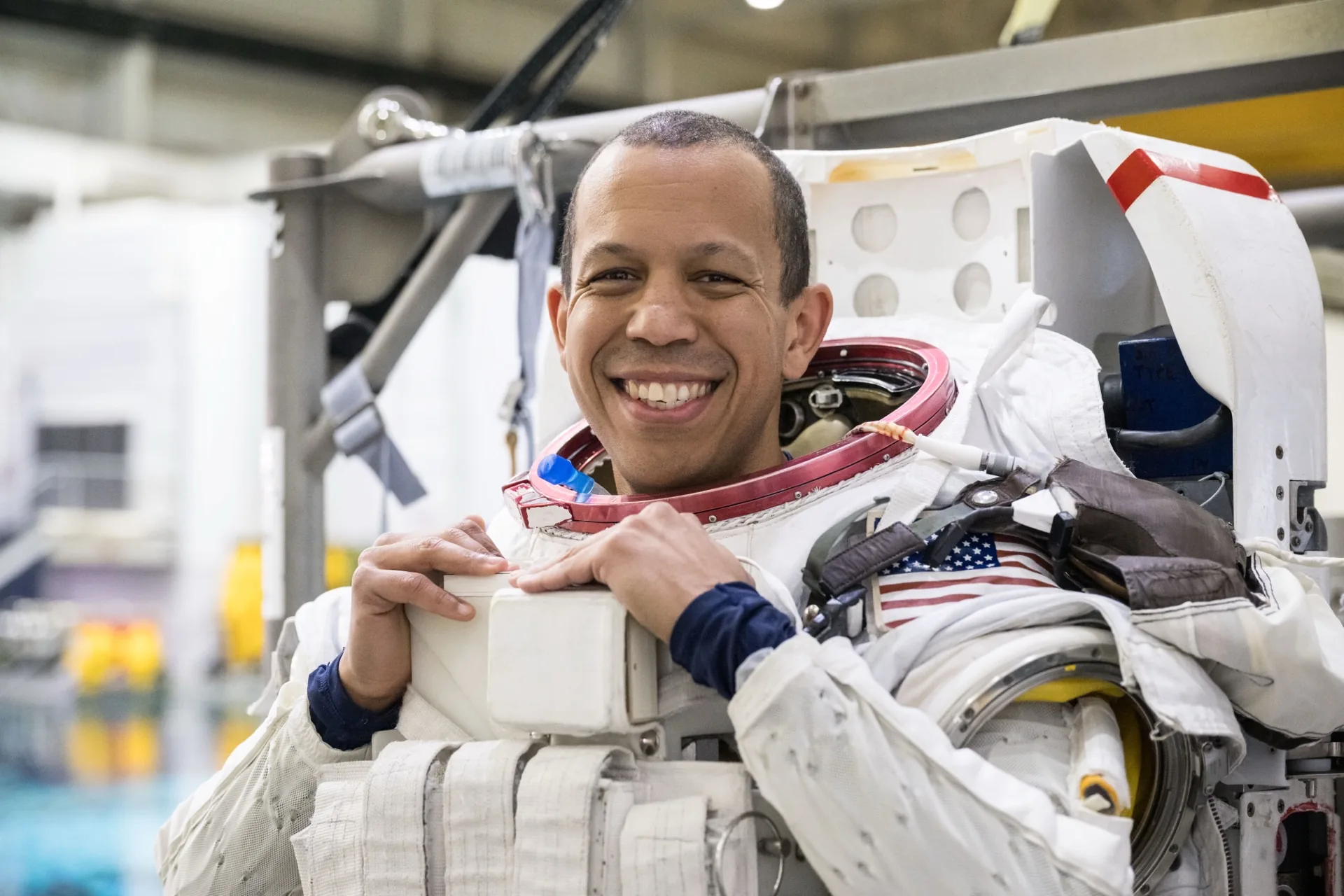
The selected candidates then enter approximately two years of training at NASA's Johnson Space Center in Houston, Texas. Training covers everything from spacewalk procedures in the Neutral Buoyancy Laboratory (a 6.2-million-gallon pool containing a full-scale ISS mockup), to robotics operations, Russian language classes, T-38 jet proficiency flights, wilderness survival, and systems engineering for whatever spacecraft they will fly.
After completing Astronaut Candidate training, you become an official astronaut, but you might wait years for a flight assignment. Some astronauts have waited five to seven years between selection and their first trip to space.
The ESA Route: Europe's Open Door
The European Space Agency ran its first new astronaut selection in over a decade in 2022, and it was a landmark event. Over 22,500 people from ESA member states applied, and the agency selected 5 career astronauts and 11 reserve astronauts. For the first time, ESA also selected an astronaut with a physical disability -- John McFall, a British Paralympian, joined the program as part of the "parastronaut" feasibility project.
ESA's requirements are similar to NASA's: a master's degree in natural sciences, medicine, engineering, mathematics, or computer sciences, plus at least three years of post-degree professional experience. Fluency in English is required, and knowledge of other languages is beneficial. Applicants must be citizens of an ESA member state or associate member state.
The ESA selection process is grueling and takes about 18 months, involving cognitive testing, psychological evaluation, medical screening, and extensive interviews. The training pipeline runs through the European Astronaut Centre in Cologne, Germany, with additional training at facilities in the United States, Russia, Japan, and Canada.
The ISRO Route: India's Rising Star
India's astronaut selection program has gained significant momentum with the Gaganyaan mission. ISRO selects its vyomanauts (the Indian term for astronauts, from the Sanskrit word for space) primarily from Indian Air Force test pilots, though the agency has indicated plans to broaden eligibility in the future.
The initial Gaganyaan crew candidates were selected from a pool of Indian Air Force pilots and underwent training at Russia's Gagarin Cosmonaut Training Center before continuing their preparation in India. As India's human spaceflight program matures, expect the selection criteria to evolve and open up to scientists and engineers.
The Commercial Astronaut Path: A New Frontier
This is where 2025 gets genuinely exciting. The rise of commercial spaceflight has created pathways to space that simply did not exist a decade ago.
Axiom Space is leading the charge with private missions to the International Space Station. Axiom missions have already flown private astronauts to the ISS, with crew members including former NASA astronauts, international payload specialists, and private citizens who have undergone Axiom's training program. These missions typically cost in the range of $55 million per seat, but Axiom is also creating opportunities for researchers, international space agencies without their own launch capability, and sponsored participants.
SpaceX has fundamentally changed the equation. The Inspiration4 mission in September 2021 sent four private citizens to orbit for three days, with crew member selection based on criteria beyond just wealth -- Hayley Arceneaux, a childhood cancer survivor and physician assistant, and Chris Sembroski, an Air Force veteran who won his seat through a charity lottery. The Polaris program, funded by Jared Isaacman, has continued to push boundaries, including the first commercial spacewalk during Polaris Dawn in 2024.
Blue Origin and Virgin Galactic offer suborbital flights, which are shorter and less physically demanding but still earn participants their astronaut wings (at least by some definitions -- the FAA updated its Commercial Space Astronaut Wings program in 2021).
For those who cannot self-fund, opportunities are growing. Several organizations now offer sponsored seats, contest-based selections, and research positions on commercial flights. The trajectory is clear: the number of people who go to space each year is climbing, and the backgrounds of those people are diversifying rapidly.
The Timeline: From Dream to Launch
Here is a realistic timeline for someone starting from scratch today:
Years 1-6: Earn a bachelor's degree in a STEM field. Focus on aerospace engineering, physics, biology, computer science, or a related discipline. Get involved in undergraduate research. Apply to co-op programs with NASA or aerospace companies.
Years 7-8: Earn a master's degree or gain two years of professional experience (or both, ideally). Build expertise in a specific area -- whether that is EVA systems, robotic surgery, geological fieldwork, or flight test engineering.
Years 8-12: Accumulate progressively responsible professional experience. Publish research. Develop leadership skills. If pursuing the military pilot route, build toward that 1,000-hour threshold. Learn a second language, ideally Russian or Mandarin.
Year 12+: Apply when NASA (or ESA, or another agency) opens selections. Be prepared to apply multiple times. Many successful astronauts applied two or three times before being selected. Peggy Whitson applied and was rejected in 1996 before being selected in 1998. She went on to hold the record for most time in space by an American astronaut.
Years 14-16: If selected, complete approximately two years of Astronaut Candidate training.
Years 16-22: Await and prepare for flight assignment. Serve in technical roles at NASA in the meantime -- working in mission control, supporting other crews, or contributing to vehicle development.
What Actually Matters Beyond the Resume
Talk to any astronaut selection board member, and they will tell you that the intangibles matter as much as the qualifications. They are looking for people who can remain calm under life-threatening pressure, who work effectively in small teams in confined spaces for months, who can fix a toilet or repair a spacesuit and then pivot to conducting cutting-edge science experiments. Emotional intelligence, adaptability, and a genuine ability to get along with others are not soft skills in this context -- they are survival skills.
Expedition crews on the ISS live and work in a space roughly the size of a six-bedroom house, with the same three to six people, for six months or more. Future missions to the Moon's surface or to Mars will be even more isolated and demanding. The people who thrive are not just the smartest or the most accomplished -- they are the ones their crewmates would trust with their lives.
The Bottom Line
Becoming an astronaut remains one of the most competitive career paths in human history. But it is no longer a single narrow road through military test piloting or a NASA lab. The paths are multiplying -- through international agencies, commercial companies, and entirely new models of crew selection. The Artemis generation is being chosen right now, and the first humans to walk on Mars are likely already somewhere in their career pipeline.
If you are reading this and the idea lights something up inside you, start building the foundation today. Get the degree. Gain the experience. Stay physically fit. Learn to work with people from every background and discipline. And when the application window opens, be ready. The odds are long, but zero percent of the people who never apply will ever see Earth from orbit.