On May 27, 2026, NASA Administrator Jared Isaacman walked reporters at the agency's Washington headquarters through the first concrete contract awards of the Moon Base era. The headline number was about $749 million, split across two lunar terrain vehicles, a lander delivery deal, and a swarm of hopper drones. The deeper story was a quiet reorganisation of how NASA buys hardware for the lunar surface — and a clearer picture of which companies will actually be driving, landing, and hopping around the south pole over the next four years. With Artemis II safely home and the broader Moon Base architecture now under a brand-new mission directorate, Phase One is where slideware becomes signed contracts.
Inside the May 27 Phase One Announcement
The Phase One window runs from today through 2029 and was framed by NASA as "the early ground work for an enduring presence on the Moon's South Pole." Isaacman, joined by acting cargo-landers director Ryan Stephan and Moon Base program executive Carlos García-Galán, used the briefing to confirm three procurement moves at once: lunar terrain vehicle (LTV) development contracts to Astrolab and Lunar Outpost, an LTV delivery contract to Blue Origin, and a JPL-managed subcontract to Firefly Aerospace for a hopper-drone technology demonstration called MoonFall. The agency's framing was deliberately Apollo-coded — "we are leveraging the NASA playbook from the 1960s," Isaacman told reporters, "figuring out what works and what doesn't in this epic science of survival because the Moon Base is as beautiful as it is hostile."
That language matters because it justifies an iterative procurement model rather than a single multi-decade megacontract. NASA is buying many small deliveries, many landers, many tech demonstrations — and then letting the surviving designs accumulate at the south pole. It is the same logic that turned the Commercial Lunar Payload Services (CLPS) program from a $2.6 billion experiment in 2018 into a real cadence of commercial Moon landings. Phase One simply applies that logic to a permanent base.
The reorganisation announced two days earlier is the structural scaffolding. NASA folded the old Exploration Systems Development and Space Operations directorates into a new Human Spaceflight Mission Directorate (HSMD) under associate administrator Lori Glaze, with the Moon Base program reporting directly into it. Aeronautics and space technology became the Research and Technology Mission Directorate (RTMD). The practical effect is that crewed lunar surface operations, robotic precursors, and commercial logistics now all live under one roof for the first time since the Constellation era.
Astrolab CLV-1: A Production Take on the FLEX Rover
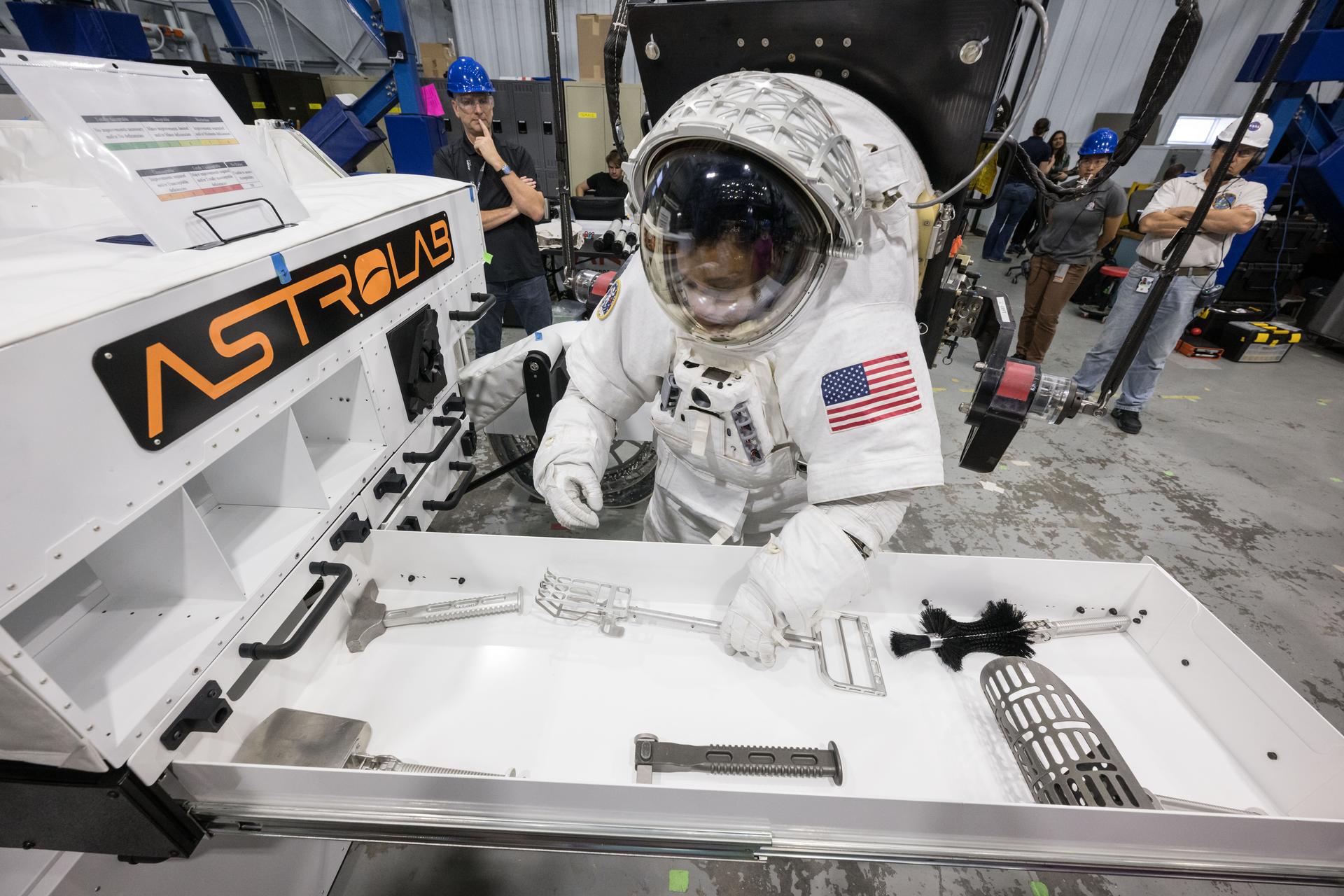
Astrolab's Crewed Lunar Vehicle, CLV-1, evolves directly out of the company's FLEX prototype — the same general architecture NASA astronauts have been climbing onto in Johnson Space Center evaluations since at least 2024. The Hawthorne, California startup, founded by former JPL roboticist Jaret Matthews, won a $220 million Phase One contract to finish the design and put a flight unit on the lunar surface during the back half of this decade.
What sets CLV-1 apart from the Apollo Lunar Roving Vehicle that Gene Cernan and Harrison Schmitt drove in 1972 is its modularity. Astrolab built FLEX as a pickup-truck chassis: it can serve as an open-cab transport for two suited astronauts, a robotic cargo hauler when uncrewed, or a science platform with stowed instruments. NASA's evaluation drawers, visible in JSC test imagery, are tightly choreographed for spacesuit gloves rather than bare hands — a real-world acknowledgement that an Artemis surface crew will be dexterity-limited in a way Apollo never quite was. The published programme baseline calls for CLV-1 to be capable of crewed traverses of roughly 10 kilometres from a landing site and uncrewed traverses totalling around 400 kilometres across its lifetime.
The $220 million is finishing money, not exploratory money. Astrolab already raised private capital and has a separate logistics contract on SpaceX's Starship manifest. What NASA is buying is a guaranteed flight slot, a heavily instrumented operational data set, and the option to refly the same platform for additional surface missions through 2029.
Lunar Outpost Pegasus: Eagle's Heir Apparent
Lunar Outpost, headquartered in Golden, Colorado, won the second $220 million LTV award for its Pegasus vehicle — a production refinement of the Eagle prototype NASA has been testing alongside the Astrolab unit. Where Astrolab leans into West Coast aerospace heritage, Lunar Outpost was incubated in the Colorado School of Mines' space resources programme and has spent years on smaller robotic rovers, including the MAPP rover that flew on Intuitive Machines' IM-2 mission to the south pole in 2025.
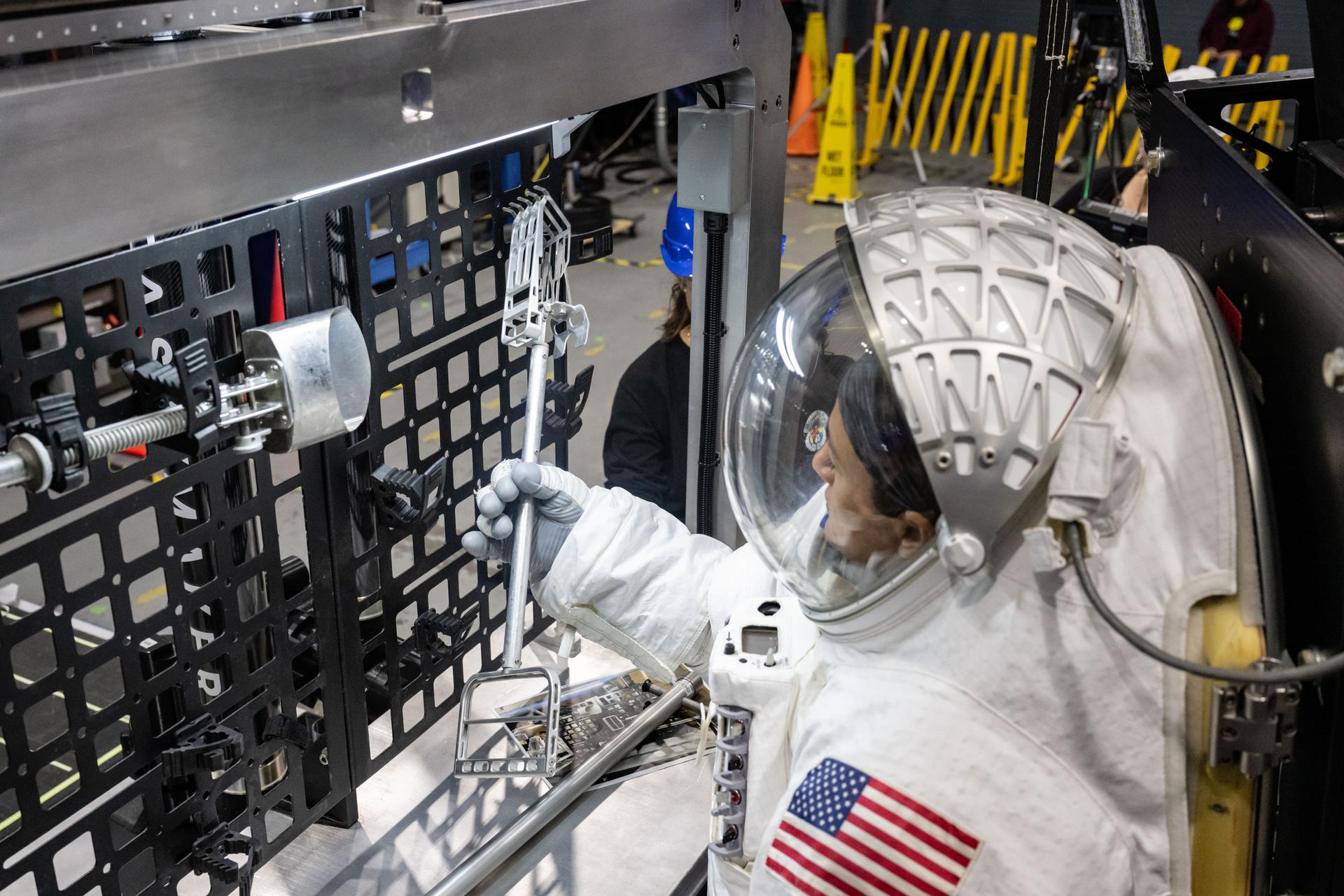
Pegasus's distinguishing feature is its modular side panels, which NASA tested as exterior tool racks — a design choice visible in the 2024 Johnson Space Center evaluations and one that simplifies the long, awkward EVA grab-and-stow choreography Apollo crews had to perform with rear-mounted equipment pallets. Lunar Outpost has also been more public than Astrolab about resource-utilisation experiments piggybacked on its rovers, which is a likely tell about where the company sees long-term revenue once NASA's Phase One spend is exhausted.
NASA's decision to fund two LTV designs in parallel — at near-identical price points — is doctrinal. The agency learned from the original Human Landing System procurement, where consolidating around a single contractor created political fragility, that it prefers competitive redundancy on critical lunar hardware. If one rover hits a development slip or fails on the surface, the other becomes the contingency rather than the only option. NASA originally specified LTVs that could survive on the Moon for up to ten years, but, as Stephan told reporters, the agency "revised its requirements to have more readily available options to augment earlier astronaut missions" — a pragmatic concession that getting any rover to the south pole by Artemis III matters more than perfecting a decade-class design first.
Blue Moon Mark 1 and the $234M LTV Delivery Contract
The third headline contract is the lander side of the equation. Blue Origin won an LTV delivery contract worth $234 million per rover delivered, using the same Blue Moon Mark 1 lander that NASA Administrator Isaacman inspected at the company's Lunar Plant 1 facility in Merritt Island in January. The first Blue Moon Mk1 mission is now baselined for Fall 2026 — making it one of three "Moon Base Missions" scheduled for the back half of this year, alongside Astrobotic's Griffin-1 (late 2026) and Intuitive Machines' IM-3 (also late 2026), both repackaged out of the original CLPS roster.
Blue Moon Mk1, the uncrewed cargo variant, can place roughly three metric tonnes on the lunar surface. It is the vehicle that will physically deliver the Astrolab and Lunar Outpost rovers, plus future cargo payloads, and is designed to land with enough precision that follow-on missions can be staged near it. CEO Dave Limp summarised Blue Origin's framing on X after the announcement: "Since the beginning, Blue Origin has been committed to Lunar Permanence."
A subtle but important operational constraint surfaced at the briefing: LTVs will not be co-deployed with crewed landers. They must be set down "approximately 2 km away when the landers land," Stephan said, because of plume-surface interaction — the lunar regolith blasted into orbital trajectories by descent-engine exhaust. Apollo missions, with their smaller Lunar Module descent stage, were far below today's HLS thrust class; modern Starship HLS and Blue Moon Mk2 throw enough mass to genuinely damage exposed rover optics from kilometres away. Phase One vehicles will therefore land, drive themselves to the surface, and then traverse to the crew landing zone — an operational profile no previous lunar mission has attempted.
Firefly MoonFall: The Hopper Drone Wild Card
The least-discussed and arguably most interesting Phase One award is the $75 million JPL-managed subcontract to Firefly Aerospace for a mission called MoonFall, targeting a 2028 launch. Firefly's Elytra Dark spacecraft will spend roughly 45 days in transit, then drop into lunar orbit, then deorbit and deploy a swarm of hopper drones at an altitude of about 50 kilometres above the lunar south pole.
Hopper drones are not rovers. They are short-lived robotic platforms — designed to last about one lunar day, or 14 Earth days — that propel themselves in ballistic arcs across the surface, landing, imaging, and lifting off again. The MoonFall hoppers' job is to collect high-resolution imagery during deployment, landing, in-situ operation, and re-hopping. García-Galán described the science payoff plainly: "It will continue image collect during an extended mission and it will analyse different sites for unprecedented detail and basically allowing us to build our understanding of soil mechanics, the terrain, the lighting conditions in-situ of wherever we want to go."
The strategic payoff is even more interesting. García-Galán confirmed that MoonFall drones can establish what he called a "Moon Base perimeter" — markers placed at the corners of areas NASA wants to either explore scientifically or build out as permanent infrastructure. Asked at the briefing whether such a perimeter could function as a keep-out zone for nations not party to the Artemis Accords, Isaacman pointed back to the Outer Space Treaty's reciprocity principle, but the geopolitical subtext was unmistakable: getting to interesting south-pole real estate first, with persistent assets in place, is part of the value proposition.
What Phase One Signals About the Decade Ahead
Three things stand out about how the Moon Base Phase One contracts were structured, and they all point at how the late-2020s lunar economy will actually run. First, the dollar amounts are deliberately modest by NASA standards. $220 million is the kind of envelope that disciplines a startup to ship rather than gold-plate; the total $749 million across four winners is less than NASA spent on the Lunar Reconnaissance Orbiter program alone over a decade. NASA is buying capability, not bespoke perfection, and is willing to pay a premium per service delivery to avoid cost-plus development risk.
Second, the directorate reorganisation puts crewed surface operations, robotic precursors, and commercial logistics under the same management for the first time since Constellation. That is significant because it removes a long-standing political seam between "exploration" and "operations" budgets — a seam that, in earlier Artemis years, made it harder to defend long-tail surface infrastructure against year-to-year budget compression. With HSMD as a single owner, the Moon Base now has a clearer political champion inside NASA than the Lunar Gateway ever did before it was partially descoped.
Third, the iterative procurement model treats lunar hardware the way SpaceX treats Falcon 9 boosters — as fleets, not unicorns. Two LTVs in parallel. Three CLPS-derived landers in late 2026. Hopper drones from 2028. None of the individual missions is fatal if it fails. The cadence is the asset. By the time Artemis III's HLS finally puts boots on the south pole, NASA wants a small but real on-surface infrastructure already in place — rovers parked at staging zones, drones marking perimeters, landers cached as fuel and pressure-vessel salvage.
The risks are obvious. Astrolab and Lunar Outpost both still need to clear flight hardware milestones. Blue Moon Mk1's Fall 2026 maiden mission is famously slippery. Firefly's Elytra Dark deep-space platform has yet to fly. SpaceX's Starship — the cargo vehicle assumed in the back half of the Phase One manifest — is currently grounded pending an FAA-mandated mishap investigation into its May 22 Flight 12 booster anomaly. None of those risks were addressed at the Phase One briefing, because NASA's bet is structural: with four independent vehicle programmes funded simultaneously, at least some of them will reach the surface on time. Phase One does not need every contract to succeed. It just needs enough of them to deliver hardware that the next phase, sometime around 2029, has a base to build on.