On June 5, 2026, NASA's X-59 quiet supersonic research aircraft broke the sound barrier for the first time. The aircraft — built by Lockheed Martin Skunk Works and operated from NASA's Armstrong Flight Research Center in Edwards, California — flew faster than Mach 1 in a milestone that ends more than two decades of stagnation in American civil supersonic flight research. Concorde made its final commercial crossing of the Atlantic in October 2003. The X-59 is the first purpose-built quiet supersonic demonstrator to reach supersonic speed.
The milestone matters because the X-59 does not merely aim to fly fast. It is engineered to fly quietly — to reduce the characteristic double-crack of a sonic boom to something closer to the sound of a car door closing a block away. The aircraft is the centerpiece of NASA's Quesst mission (Quiet SuperSonic Technology), which has one concrete objective: demonstrate that a supersonic aircraft can generate a shaped pressure wave so gentle that people on the ground will not object to it. If the data supports that case, the Federal Aviation Administration may revise an overland supersonic ban that has stood since 1973.
Why the FAA Banned Supersonic Flight Over Land Since 1973
Commercial supersonic flight over the continental United States was prohibited by the FAA in March 1973, fourteen months before Concorde entered service. The rule was not aimed at Concorde specifically — it responded to the Boeing SST and Lockheed L-2000 test programs of the 1960s, during which sonic booms were loud enough to rattle windows, crack plaster in older buildings, and generate tens of thousands of public complaints filed with Congress. The regulation, codified in Title 14 of the Code of Federal Regulations, prohibits any civil aircraft from intentionally exceeding Mach 1 over U.S. land without specific authorization.
Concorde's commercial routes consequently ran exclusively over open ocean, operating between the U.S. East Coast and Western Europe — the only city pairs where the Atlantic was the entire flight path. It never legally flew supersonic over U.S. or most European territory. That constraint, combined with operating costs that required per-seat fares far beyond business-class subsonic competition, kept the aircraft profitable only on a handful of routes even in its peak years.
The 1973 rule is not technically permanent. The FAA has the authority to revise its regulations in response to new evidence. What has been lacking for five decades is credible data showing that a quieter boom is achievable in practice and that the public would accept it. The Quesst mission was designed to supply exactly that evidence.
NASA's target is a shaped pressure wave measured at approximately 75 Perceived Level decibels (PLdB) at the ground. A conventional supersonic aircraft generates booms exceeding 100 PLdB — roughly comparable to a thunderclap directly overhead. At 75 PLdB, the X-59's boom is designed to register below the ambient sound level of many suburban neighborhoods. Whether that threshold crosses the line from "noticeable" to "acceptable" in the public's perception is the empirical question that community overflight testing is designed to answer.
What Is the X-59 and Why Does Its Nose Look Like That?
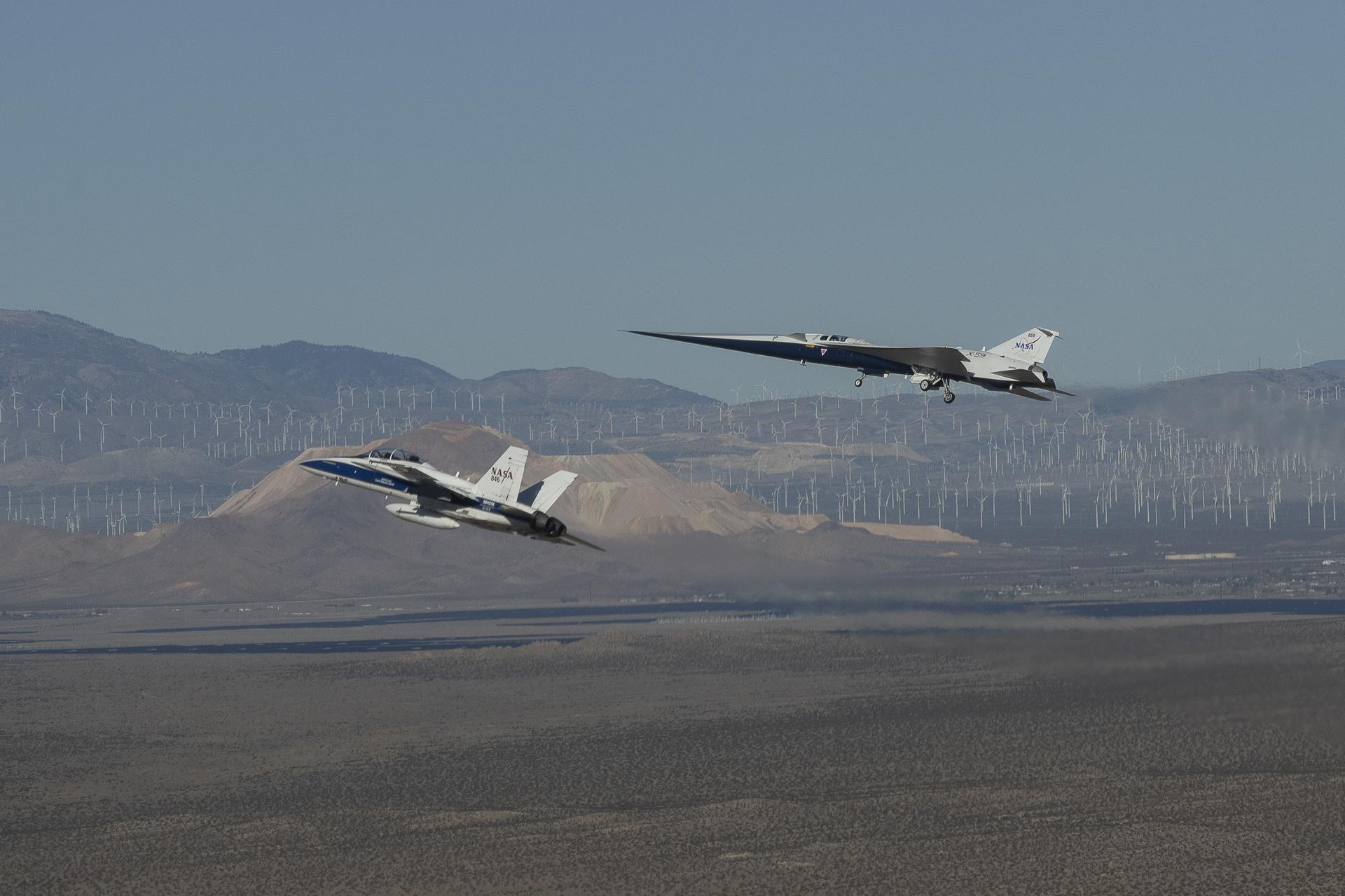
The X-59 is a single-seat research aircraft measuring 99.7 feet (30.4 meters) in length, with a wingspan of 29.5 feet (9 meters) and a maximum takeoff weight of approximately 32,300 pounds. It is powered by a single General Electric F414-GE-100 engine — the same engine family used in F/A-18E/F Super Hornet naval fighters — delivering approximately 22,000 pounds of thrust. Design cruise speed is Mach 1.42 at an altitude of approximately 55,000 feet.
The most visually arresting feature is the nose. The X-59's needle-shaped front section extends 38 feet in front of the cockpit — roughly 38 percent of the aircraft's entire length. That proportion is not aesthetic. It is the primary mechanism by which the aircraft reshapes its sonic signature.
A conventional supersonic aircraft generates a loud sonic boom by allowing the pressure waves from its different structural features — the nose, cockpit canopy, engine inlet, wings, and tail — to travel through the air at similar speeds and coalesce into a single powerful shockwave before they reach the ground. The merged wave arrives as the familiar double thunderclap. The X-59 prevents that coalescence. Its elongated nose spreads the initial pressure wave over a longer physical distance, and the aircraft's delta wing geometry and over-the-fuselage engine placement prevent the subsequent pressure pulses from catching up. The result is a dispersed train of weak, separated pulses — what NASA calls a "sonic thump" rather than a boom.
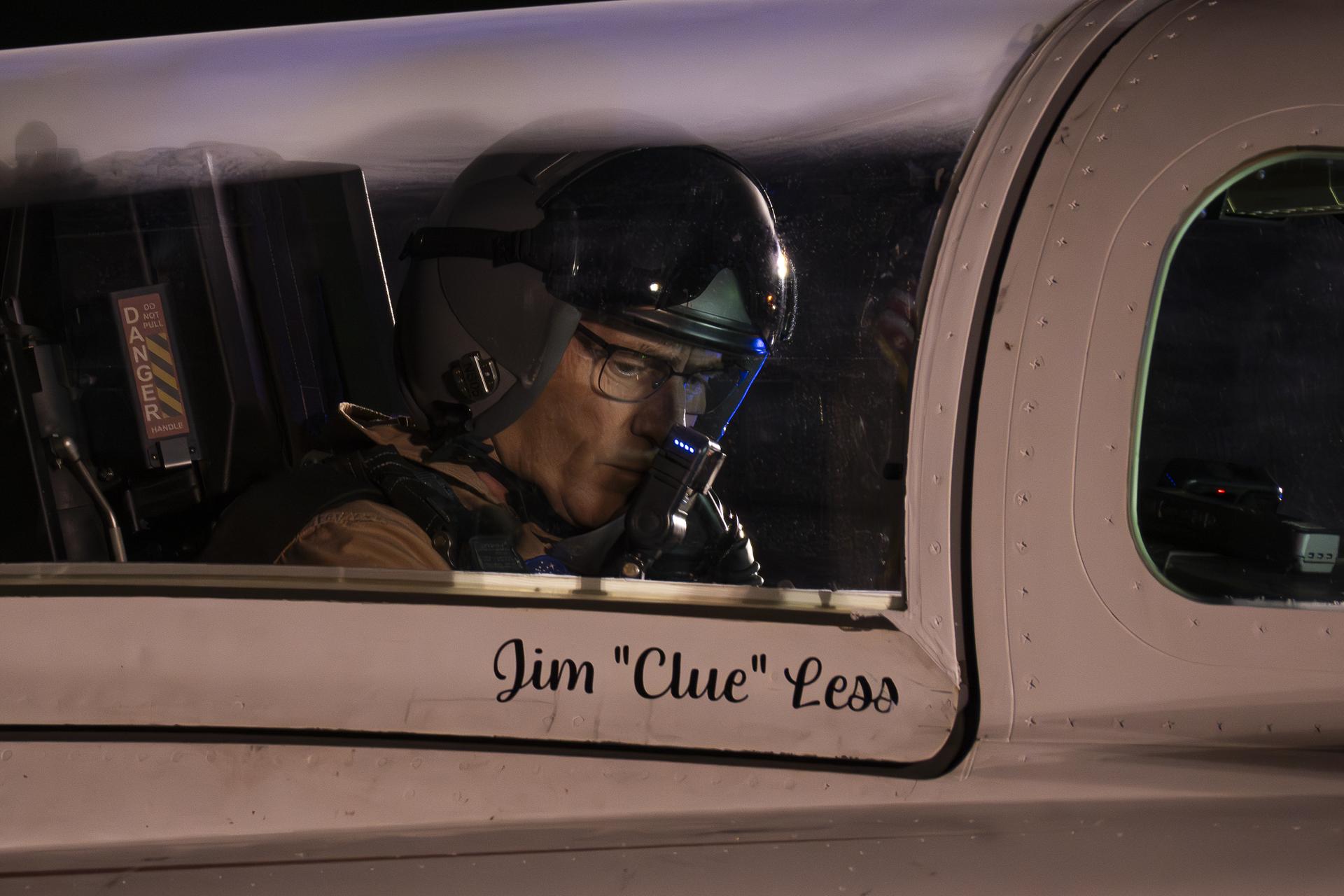
The cockpit configuration is an unusual engineering consequence of the nose design. The nose extends so far forward that it entirely blocks the pilot's forward sightline. The X-59 therefore has no conventional forward-facing windshield. The pilot navigates using an External Vision System: high-resolution cameras mounted on the airframe feed imagery to a large display in front of the pilot, supplemented by synthetic vision derived from GPS and terrain databases. A small side window above and to the left exists for emergency reference. Normal forward visibility in the X-59 is entirely screen-based — a configuration that anticipates, in miniature, the sensor-fused cockpit architectures now appearing in advanced military aircraft.
Lockheed Martin's Skunk Works division — the same advanced development program that produced the U-2 high-altitude reconnaissance aircraft, the SR-71 Blackbird, and the F-117 stealth fighter — developed the X-59 under a contract with NASA valued at approximately $247.5 million, signed in April 2018.
From Palmdale to Edwards: The X-59's Road to Its First Supersonic Flight
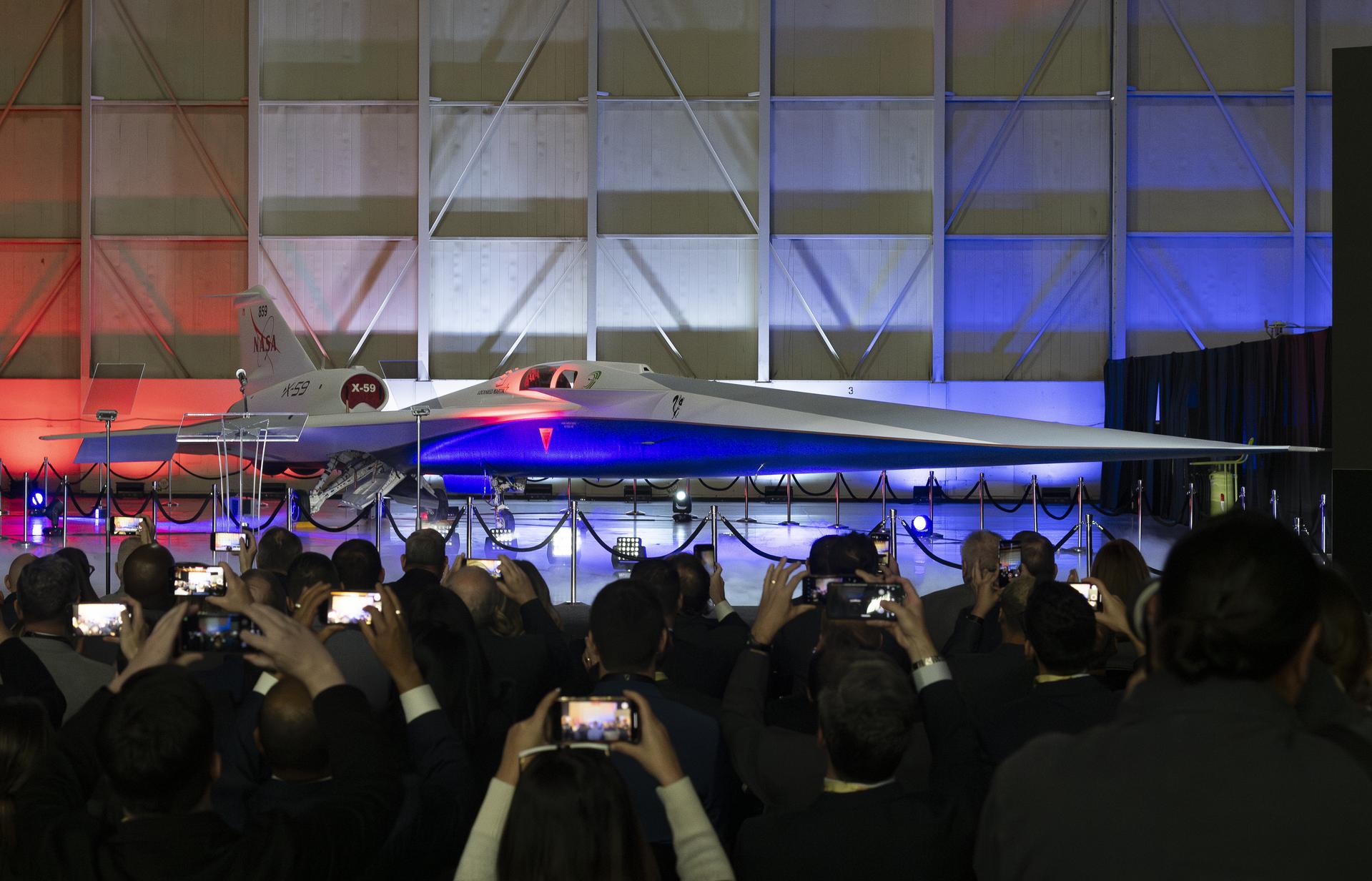
The X-59's development ran longer than originally scheduled. NASA's Low Boom Flight Demonstrator program, later rebranded as Quesst, was conceived in the mid-2010s. Assembly took place at Lockheed's Palmdale facility through 2022 and 2023. The aircraft was unveiled publicly on January 12, 2024, at a ceremony at Skunk Works, where the completed airframe — painted white with blue and red trim, marked "859" on the tail alongside the NASA logo — was shown to invited guests and press for the first time.
Ground testing followed. Taxi runs and engine tests were conducted at Palmdale before the aircraft was declared ready for its first flight. That milestone came on October 28, 2025, when the X-59 flew from Palmdale to Armstrong Flight Research Center at Edwards Air Force Base, accompanied by a NASA F/A-18 chase aircraft that monitored its systems throughout the transit. The flight was subsonic — a handling qualities evaluation and ferry to its operational home, not a speed test.
Engine run testing continued at Armstrong through early 2026. On March 12, 2026, engineers conducted a series of engine runs on the ramp at Edwards in preparation for the next flight. A second flight departed Edwards on March 20, 2026, extending the aircraft's flight envelope further while remaining below Mach 1.
On June 5, 2026, the X-59 flew supersonic for the first time, exceeding Mach 1 during a scheduled test sortie from Armstrong. NASA confirmed the milestone as part of its regular aeronautics program updates. No community noise measurements were collected during the June 5 flight — the supersonic breakthrough was achieved in designated flight test airspace, not over populated areas. The acoustic data that matters for the Quesst mission's regulatory goals will come from the community overflight phase still ahead.
What the Quesst Mission Must Prove Before FAA Rules Can Change
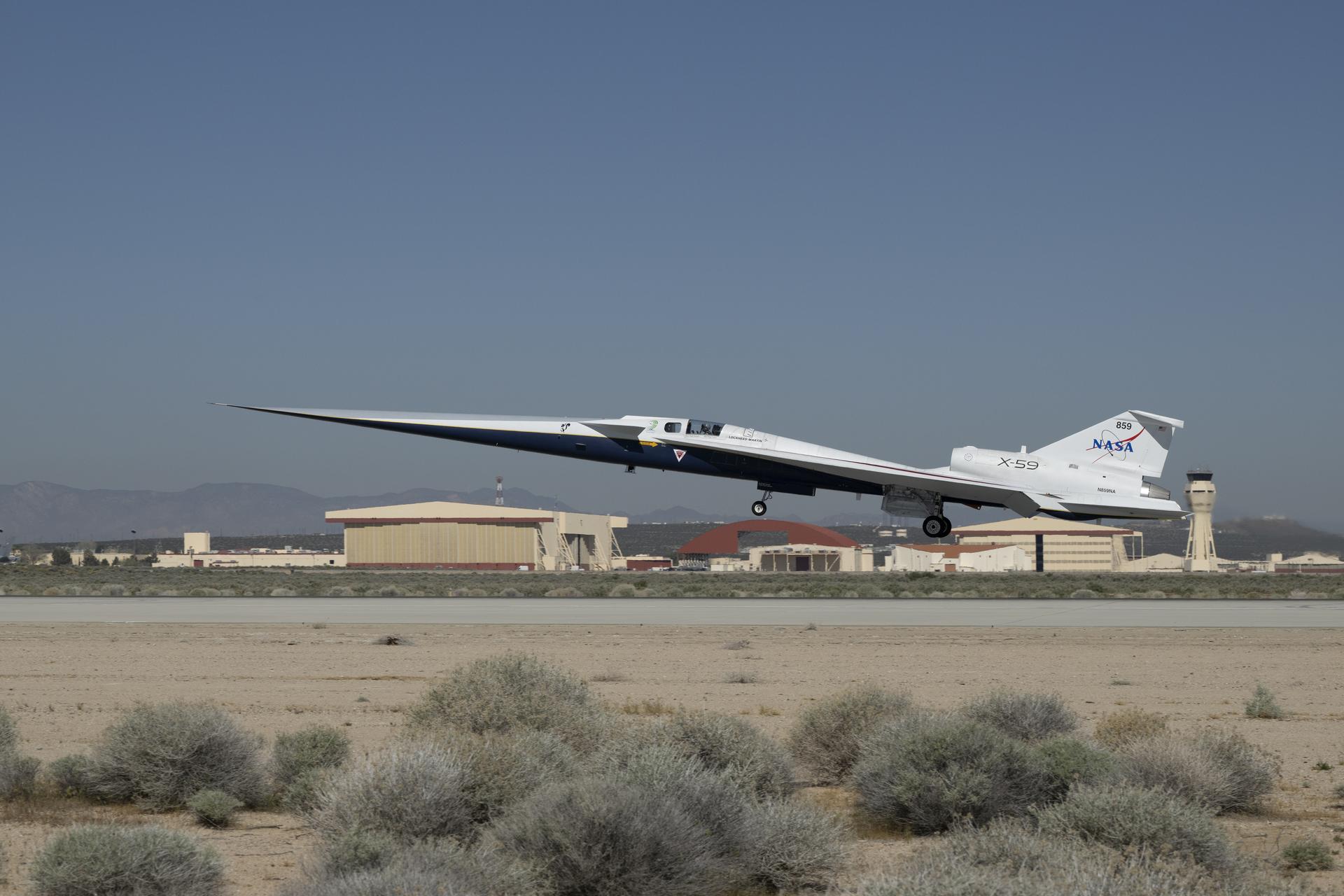
Achieving supersonic flight is a hardware milestone. The scientific work of the Quesst mission is still in front of the X-59 team.
The next phase calls for the aircraft to fly supersonic over several U.S. cities at cruise altitude while community members on the ground record what, if anything, they heard. Participants will not be told in advance when the aircraft is overhead. Their responses — collected through standardized surveys developed in collaboration with NASA's social science team — will form a dataset that the FAA and the International Civil Aviation Organization (ICAO) can assess when evaluating potential changes to overland supersonic rules.
The specific cities to be overflown have not been publicly announced as of June 2026. NASA has indicated that selections will represent a range of background noise environments — urban, suburban, and quieter rural settings — so the dataset reflects varied real-world listening conditions rather than those optimized for favorable outcomes.
Community overflight testing is planned to run through 2027. Data from those flights will then be submitted to the FAA and to ICAO, which sets global civil aviation standards. Both bodies would need to independently revise their rules before commercial supersonic over-land operations could be authorized. The FAA has committed to evaluating the evidence when it is available but has made no prior commitment about what rulemaking would follow.
This multi-year evidentiary pathway is a familiar pattern in aerospace regulation. Nuclear propulsion for space travel, to take one analogy, has been technically demonstrated for decades while awaiting the regulatory and political frameworks needed to enable operational use. The X-59's data may be compelling; translating it into a revised FAA rule will require a separate process with its own timeline.
The Commercial Supersonic Market Waiting for Regulatory Permission
The X-59 is a research aircraft, not a commercial prototype, but the market it is designed to unlock is real. Several companies have built supersonic commercial aircraft programs on the assumption that overland supersonic will eventually receive regulatory permission.
Boom Supersonic, based in Centennial, Colorado, is developing the Overture, targeting a cruise speed of approximately Mach 1.7 with capacity for up to 80 passengers in an all-premium configuration. American Airlines and United Airlines have each signed purchase agreements conditional on Overture meeting performance, economics, and regulatory certification criteria. Boom's XB-1 demonstrator aircraft completed its first flight in October 2023 and became the first independently developed civil jet to break the sound barrier when it flew supersonic over California's Mojave Desert on January 28, 2025, reaching Mach 1.122 — a feat it repeated on a second supersonic test flight on February 10, 2025.
Aerion Supersonic, at one point the best-funded entrant in quiet supersonic business jets, suspended operations in May 2021 after failing to secure the production funding needed to proceed to manufacturing. The company's collapse illustrated the commercial reality: without regulatory certainty about overland operation, the market for a quiet supersonic jet is constrained to transoceanic routes, a segment too narrow to justify the development investment at commercial scale.
The Quesst mission represents the primary path to closing that uncertainty. A credible, peer-reviewable dataset showing that communities find the X-59's boom acceptable would give manufacturers a regulatory target to design toward — and give airlines the confidence to place firm orders rather than conditional ones. Without it, any business case for commercial supersonic over land remains speculative regardless of how impressive the aircraft's performance specifications are.
The potential size of the market, if the regulatory path opens, is substantial. Supersonic flight at the speeds Boom and others are targeting would reduce New York-to-London flight time from approximately seven hours to approximately three and a half. Los Angeles to Tokyo would fall from roughly eleven hours to approximately six. At those compression ratios, the premium that business and ultra-premium travelers will pay for speed is historically large — Concorde's ticket prices routinely ran at multiples of first-class subsonic fares on the same routes.
Why the X-59's Supersonic Milestone Matters Beyond Aviation
The first supersonic flight of the X-59 is easy to underrate in a news environment that leads with rocket launches, moon programs, and Mars missions. The fastest spacecraft ever built travel at tens of thousands of miles per hour in the vacuum of space, where aerodynamic constraints do not apply. The X-59 cruises at roughly 940 miles per hour inside the atmosphere — a domain where the engineering of shaped pressure waves is vastly more complex than in vacuum.
The sonic boom problem has resisted solution not for lack of trying. Every major supersonic aircraft program since the 1960s has confronted it and accepted the constraint rather than solved it. Concorde simply flew over water. Military aircraft receive blanket exemptions. The X-59 is the first dedicated program to engineer around the physics of boom formation rather than route around it.
The June 5 flight confirms that the aircraft can sustain supersonic cruise as designed. The harder confirmation — whether the boom it generates on the ground is as quiet as the models predict, and whether communities will rate it as acceptable — depends on the overflight program still ahead. The engineering test is complete. The social science test begins next.
If the Quesst data supports what the models predict, it would mark the first genuine regulatory opening for overland supersonic civil flight in more than fifty years. That would reshape long-haul commercial aviation in ways comparable to how the reusable rocket revolution reshaped the economics of reaching orbit — not by changing the physics, but by making something technically possible also commercially and operationally viable.
The X-59 has flown fast. What happens next is about whether people on the ground noticed — and what they said when they did.