Space Debris & Reentry Watch
More than 36,500 tracked objects — and over a hundred million smaller fragments — now share Earth orbit with 11,000 working satellites. Here is how much debris is up there, the events that created it, and why some of it will never come down.
Watch a breakup unfold
Pick a real event and scrub through time to watch how a single collision or anti-satellite test spreads from a point into a cloud, then a ring, then a shell of debris that threatens everything crossing that altitude.
T+ 0.0 h
since breakup
Illustrative: 700 fragments from Cosmos 1408 (Russian ASAT test) (~1,500 tracked) propagated with representative dispersion physics — not the exact catalogued objects. A 2021 direct-ascent anti-satellite test shattered a defunct Soviet ELINT satellite, forcing the ISS crew to shelter.
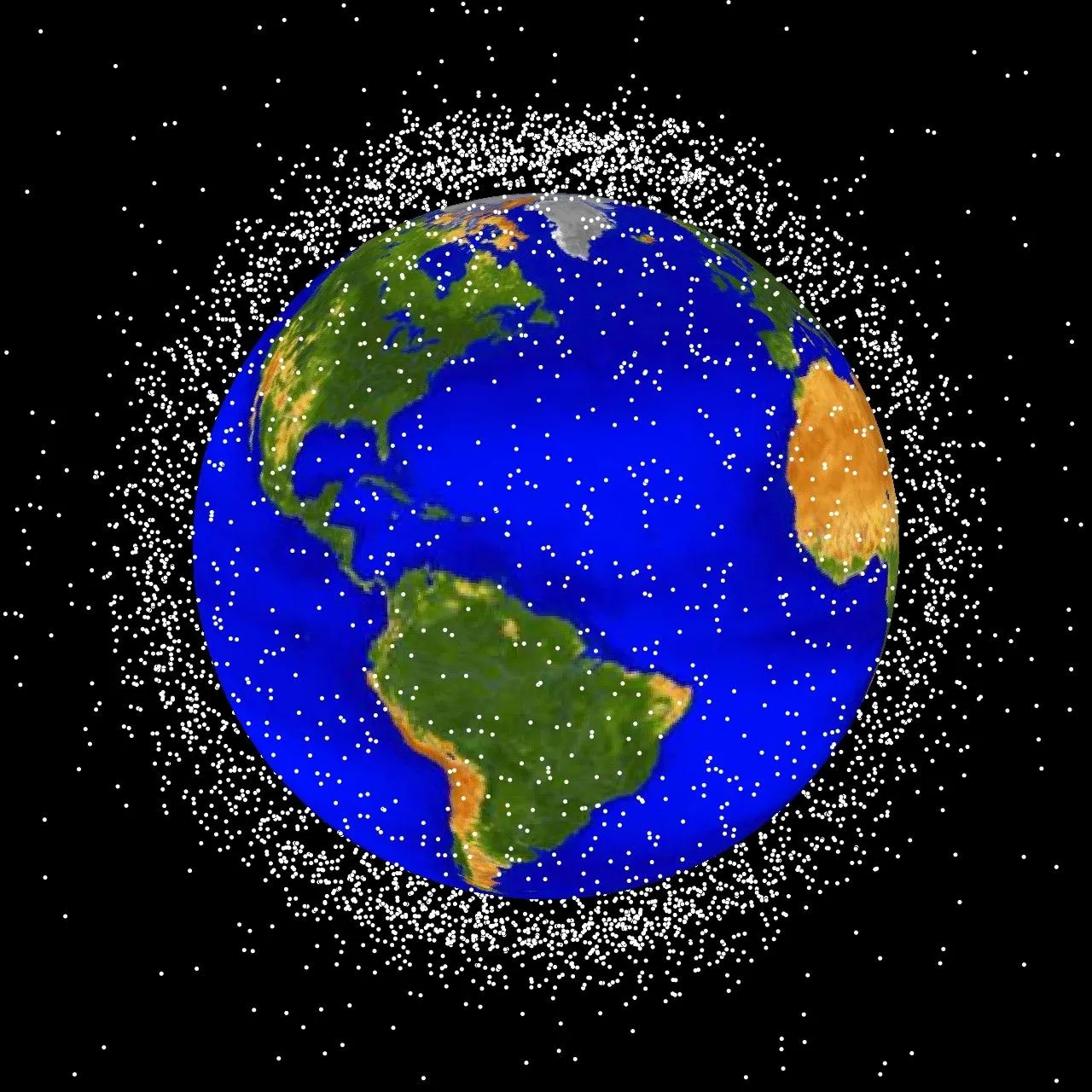
How much debris is in orbit?
Tracked objects (>10 cm)
36,500
Objects large enough to be tracked by ground radar. Includes active satellites, rocket bodies, and debris fragments.
Estimated debris (1–10 cm)
1,000,000
Too small to track reliably but large enough to destroy a satellite on impact. Traveling at 7–8 km/s in LEO.
Estimated debris (<1 cm)
130,000,000
Tiny paint flakes, solid rocket motor slag, and fragments. Can damage spacecraft surfaces, solar panels, and optics.
Active satellites
11,000
Currently operational satellites across all orbits. Has tripled since 2020 due to mega-constellations.
Defunct satellites
4,000
Dead satellites still in orbit. Many will take decades or centuries to naturally deorbit without active removal.
Rocket bodies in orbit
2,500
Spent upper stages from launches dating back to the 1960s. Some of the largest uncontrolled debris objects.
Recent reentries
Loading…Catalogued objects that have decayed from orbit and reentered Earth's atmosphere in the last 30 days — payloads, spent rocket bodies, and debris. Sourced from the U.S. space-surveillance catalogue via CelesTrak.
Loading the latest reentries…
What is the Kessler Syndrome?
The Kessler Syndrome, proposed by NASA scientist Donald Kessler in 1978, describes a runaway cascade: once the density of objects in an orbital shell crosses a threshold, each collision generates fragments that trigger further collisions, multiplying debris faster than it can decay. In the worst case, certain altitudes could become unusable for generations. The 2007 Chinese ASAT test and 2009 Iridium–Cosmos collision showed how quickly a single event can seed thousands of long-lived fragments — which is why end-of-life disposal, collision avoidance, and active debris removal now dominate orbital-sustainability policy.
Major debris events
2025
Starlink Satellite Anomaly
FragmentationA Starlink satellite suffered an anomaly, releasing propellant and a cluster of objects. Low altitude means most debris re-enters within months — a contrast to high-orbit breakups.
2024
Long March 6A Upper-Stage Fragmentation
FragmentationThe upper stage of a Long March 6A broke apart after deploying Qianfan satellites, creating 283+ trackable fragments and potentially thousands of smaller pieces in a busy orbital shell.
283+ fragments created · LEO (~810 km)2024
Intelsat 33e Breakup (GEO)
FragmentationThe Boeing-built Intelsat 33e broke apart in geostationary orbit. Unlike LEO debris, GEO fragments effectively never decay — they remain a permanent hazard to the crowded GEO belt.
4,393+ fragments created · GEO (~35,786 km)2023
The Conjunction-Alert Era
TrendESA reports collision-avoidance alerts for its satellites rose roughly 5× from 2019 to 2023, driven by mega-constellation growth — a structural shift, not a single event.
2021
Russia ASAT Test (Cosmos 1408)
ASAT testRussia destroyed its own Cosmos 1408 satellite with a direct-ascent missile, creating 1,500+ trackable fragments. ISS crew sheltered in their return vehicles.
1,500+ fragments created · LEO (~480 km)2009
Iridium–Cosmos Collision
CollisionActive Iridium 33 collided with defunct Russian Cosmos 2251 at 11.7 km/s, creating 2,300+ trackable fragments — the first accidental hypervelocity collision between two intact satellites.
2,300+ fragments created · LEO (~789 km)2007
China ASAT Test (Fengyun-1C)
ASAT testChina destroyed its Fengyun-1C weather satellite with a missile, creating 3,500+ trackable debris fragments — the worst single debris event in history. Fragments still in orbit.
3,500+ fragments created · LEO (~865 km)Frequently asked questions
How much space debris is in orbit?▾
As of 2026, space-surveillance networks regularly track and catalogue more than 40,000 objects in orbit, while ESA's models estimate around 54,000 objects larger than 10 cm, roughly 1.2 million between 1 and 10 cm, and over 140 million fragments smaller than 1 cm. Debris travels at 7–8 km/s in low Earth orbit — fast enough for a 1 cm fragment to disable a satellite.
What was the worst space debris event?▾
China's 2007 anti-satellite test against the Fengyun-1C satellite was the worst single event, creating over 3,500 trackable fragments at an altitude where they will persist for centuries. The 2009 Iridium–Cosmos collision (2,300+ fragments) and 2021 Russian Cosmos 1408 ASAT test (1,500+) followed.
Why is debris in geostationary orbit worse than in low orbit?▾
Low Earth orbit debris is slowed by the upper atmosphere and re-enters within months to decades. Geostationary debris, at ~35,786 km, experiences effectively no atmospheric drag, so fragments — like those from the 2024 Intelsat 33e breakup — remain in the crowded GEO belt essentially permanently.
What is the Kessler Syndrome?▾
The Kessler Syndrome, proposed by NASA scientist Donald Kessler in 1978, describes a runaway cascade: once the density of objects in an orbital shell crosses a threshold, each collision generates fragments that trigger further collisions, multiplying debris faster than it can decay. In the worst case, certain altitudes could become unusable for generations. The 2007 Chinese ASAT test and 2009 Iridium–Cosmos collision showed how quickly a single event can seed thousands of long-lived fragments — which is why end-of-life disposal, collision avoidance, and active debris removal now dominate orbital-sustainability policy.
Data sourced from ESA Space Debris Office, NASA Orbital Debris Program Office, and U.S. Space Command catalog reporting. © SpaceOdysseyHub.