ASAT testJanuary 11, 2007
China ASAT Test (Fengyun-1C)
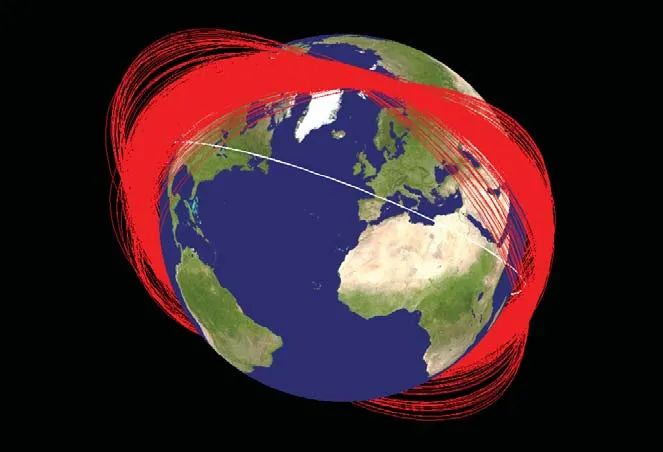
On 11 January 2007, China conducted a direct-ascent anti-satellite test against its defunct Fengyun-1C weather satellite at roughly 865 km altitude. The hypervelocity impact shattered the satellite into more than 3,500 trackable fragments and an estimated 150,000 smaller pieces — the single largest debris-generating event ever recorded. Because the collision occurred in a high, slow-decaying orbit, a large share of the fragments remain in space nearly two decades later and will persist for centuries.
At a glance
- Date
- January 11, 2007
- Type
- ASAT test
- Orbit regime
- LEO (~865 km)
- Trackable fragments
- 3,500+
In depth
On 11 January 2007, China launched an SC-19 direct-ascent missile from the Xichang Satellite Launch Centre and drove its kinetic kill vehicle head-on into the defunct Fengyun-1C weather satellite at roughly 865 km altitude, in a near-polar sun-synchronous orbit. The two bodies met at a closing speed of about 8 km/s — fast enough that no explosive was needed. The satellite was simply pulverised into a cloud of hypervelocity shrapnel. It remains the single largest debris-generating event in the history of spaceflight.
The impact produced more than 3,000 trackable fragments — pieces large enough for the U.S. Space Surveillance Network to catalogue individually, with the count rising past 3,400 over the following years — and NASA's Orbital Debris Program Office estimates roughly 35,000 pieces larger than one centimetre in all. In a single stroke the test increased the catalogued low-Earth-orbit debris population by roughly 25 percent. Crucially, the collision happened in a high, slow-decaying shell, so most of the cloud has stayed aloft: on the order of 2,800 fragments were still catalogued in the mid-2020s, and a large share are expected to persist for decades to centuries. The debris now threads through some of the most heavily used orbits. In early 2013 the Russian laser-ranging satellite BLITS was knocked out of its spin — its rotation period changing abruptly — by a suspected Fengyun-1C fragment, and the International Space Station has repeatedly manoeuvred, and seen fragments pass within a few kilometres, from the cloud.
The test drew immediate international condemnation and became the defining case study for why destructive anti-satellite demonstrations are so damaging: a few seconds of impact seeds a hazard that outlives the political moment by generations. In its aftermath, China is reported to have shifted toward debris-free ASAT approaches, and the event is routinely cited alongside the 2009 Iridium–Cosmos collision as evidence of how quickly a single act can push a busy orbital regime toward Kessler-syndrome conditions. It remains a permanent fixture in conjunction-screening catalogues and a benchmark against which every later breakup is measured.
Frequently asked questions
How many fragments did the 2007 Fengyun-1C ASAT test create?
The impact generated more than 3,000 trackable fragments catalogued by the U.S. Space Surveillance Network — a count that climbed past 3,400 in the years that followed — plus an estimated 35,000 or so pieces larger than one centimetre and vastly more untrackable debris. It is the largest single debris-generating event ever recorded, having increased the catalogued low-Earth-orbit debris population by roughly 25 percent.
Are the Fengyun-1C fragments still in orbit?
Yes. Because the satellite was destroyed at around 865 km — a high, slow-decaying orbit — most of the cloud is still up there. On the order of 2,800 fragments remained catalogued through the mid-2020s, and a large fraction are expected to stay in orbit for decades to centuries.
Has the debris caused any actual damage?
Yes. In early 2013 the Russian BLITS laser-ranging satellite was struck by a suspected Fengyun-1C fragment, knocked off its rotation, and ceased operations. The International Space Station and many other spacecraft have also had to perform collision-avoidance manoeuvres, and have seen fragments pass within a few kilometres, on account of the cloud.
Why was this test so much worse than a normal satellite failure?
It was a deliberate hypervelocity kinetic strike in a high orbit. The roughly 8 km/s head-on impact shattered the whole satellite into tens of thousands of fast-moving pieces, and the high altitude means those pieces decay extremely slowly — so a few seconds of impact created a hazard that will persist far longer than the political controversy it caused.
Related
Data sourced from ESA Space Debris Office, NASA Orbital Debris Program Office, and U.S. Space Command catalog reporting. © SpaceOdysseyHub.