Trend2023
The Conjunction-Alert Era
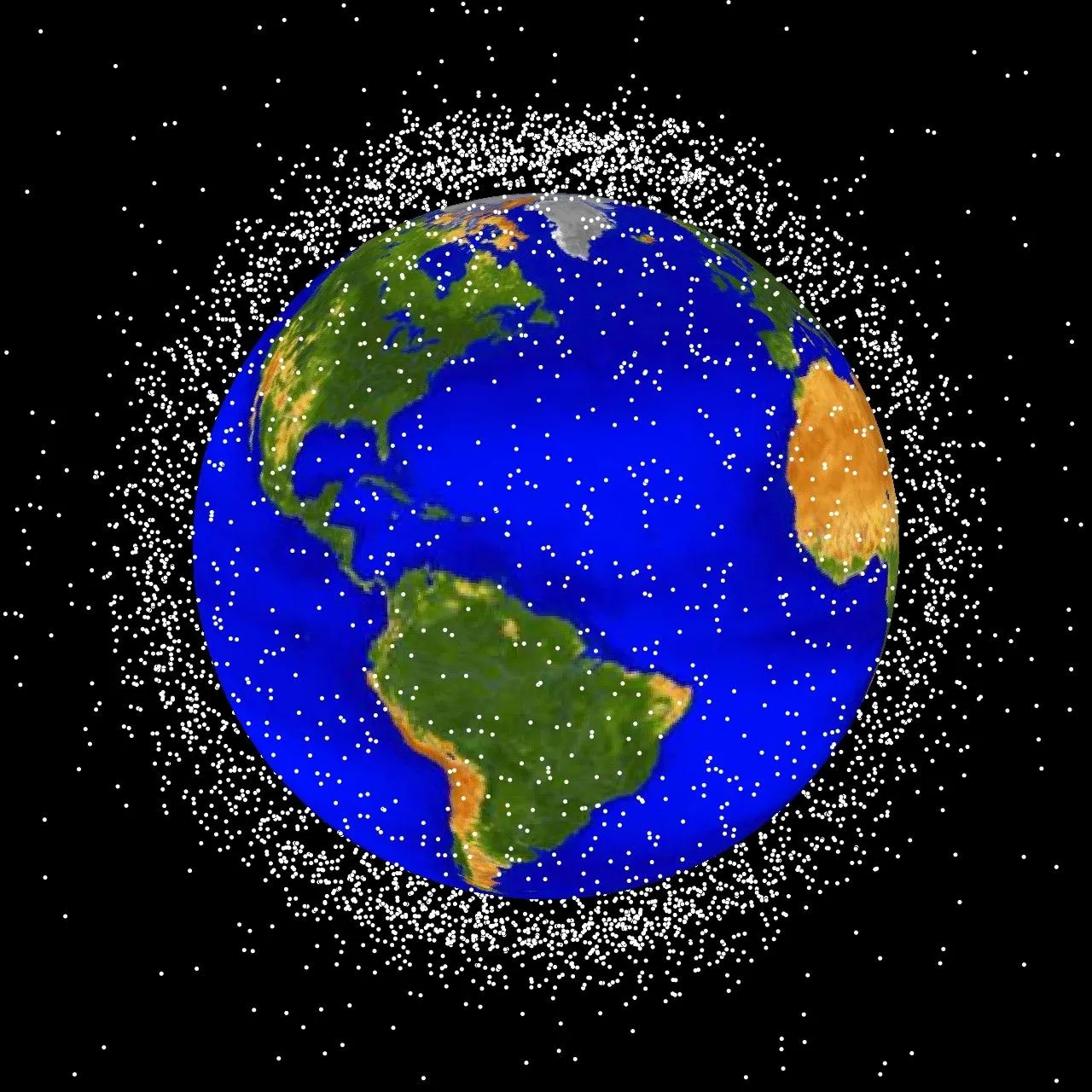
Rather than a single breakup, this entry captures a structural shift: as active satellites tripled after 2020, the European Space Agency reported that close-approach (conjunction) alerts for its fleet rose roughly fivefold between 2019 and 2023, with operators now performing collision-avoidance manoeuvres routinely. The growth of mega-constellations has made space-traffic management a continuous operational burden and a central argument for active debris removal and stricter end-of-life disposal rules.
At a glance
- Date
- 2023
- Type
- Trend
- Orbit regime
- All regimes
- Trackable fragments
- —
In depth
This is not a single breakup but a structural change in how spaceflight is run. As the number of active satellites roughly tripled after 2020 — passing 11,000 working payloads against a tracked catalog of some 40,000 objects — routine flight in low Earth orbit stopped being a matter of launch and forget. The trigger is arithmetic: every new satellite must be screened against every other tracked object several times a day, and the number of pairings grows far faster than the number of spacecraft. Mega-constellations, led by SpaceX's Starlink, sit at the centre of the shift. For a typical low-orbit satellite, space-surveillance networks now issue hundreds of close-approach warnings — 'conjunction data messages' — every week; automated filtering knocks most down to roughly a couple of actionable alerts per satellite per week, each of which a human analyst must judge. Under the long-standing industry and ESA convention, a conventional operator commands an evasive manoeuvre once the estimated collision probability crosses about one in ten thousand — though some operators, SpaceX among them, act on far lower probabilities, which is one reason their manoeuvre counts run so high.
The scale of the response makes the trend concrete. The European Space Agency reports that, on average, it now performs more than one collision-avoidance manoeuvre per satellite per year, the vast majority to dodge debris rather than other working craft, and it notes that the number of alerts triggering these procedures has been climbing year on year. Starlink's own regulatory filings show the steepest curve: its satellites altered course about 13,600 times in the second half of 2022, more than 25,000 times in the six months to May 2023, close to 50,000 in the half-year to May 2024, and roughly 144,000 in the December 2024 to May 2025 window — a count that climbed steeply, roughly doubling every six months as the fleet grew before levelling off at extraordinary volumes. Behind those manoeuvres sits an untracked hazard the catalogue cannot see: ESA estimates over 50,000 objects larger than 10 cm and more than 1.2 million larger than 1 cm, most too small to track yet large enough to destroy a satellite on impact.
The aftermath is a permanent operational burden and a policy argument. Space-traffic management, once an occasional exercise, is now continuous, and analysts warn that manual, operator-by-operator coordination does not scale — driving efforts toward automated collision avoidance, shared conjunction data, and civil traffic-coordination systems such as the U.S. TraCSS, which began onboarding operators in 2024-2025. The conjunction-alert era is the day-to-day face of the debris problem the Kessler Syndrome warns about: it is why stricter end-of-life disposal rules — such as the FCC's five-year deorbit requirement that replaced the old 25-year guideline — lower operating altitudes that self-clean in months, and active debris removal have moved from academic proposals to the core of orbital-sustainability policy.
Frequently asked questions
What is a conjunction alert and why have they become so common?
A conjunction alert (formally a conjunction data message) is a warning that two catalogued objects are predicted to pass dangerously close. They have surged because the number of active satellites roughly tripled after 2020 — to around 11,000 working payloads among some 40,000 tracked objects — and the number of close-approach pairings that must be screened grows far faster than the number of satellites. ESA notes that for a typical low-orbit satellite, hundreds of such messages are issued each week, filtered down to roughly two that require analyst follow-up.
How much have collision-avoidance alerts actually increased?
The European Space Agency reports that it now performs more than one avoidance manoeuvre per satellite per year — the vast majority to dodge debris — and that the number of alerts triggering these procedures rises year on year. SpaceX's Starlink shows the steepest curve of all: from about 13,600 manoeuvres in the second half of 2022 to more than 25,000 by May 2023, close to 50,000 by May 2024, and roughly 144,000 in the December 2024 to May 2025 window — climbing steeply, roughly doubling every six months as the fleet grew.
When does an operator actually move a satellite versus just monitor?
Most alerts are cleared automatically as low-risk. Under the long-standing industry and ESA convention, an operator commands an evasive manoeuvre when the estimated collision probability crosses a threshold of about one in ten thousand; some operators, including SpaceX, act on far lower probabilities, which drives up their manoeuvre counts. Either way, the vast majority of manoeuvres are to avoid debris fragments rather than other active satellites, because uncontrolled debris cannot get out of the way.
Is this a single debris event, and how many fragments did it create?
No — the conjunction-alert era is a trend, not a breakup, so it created no fragments of its own. It reflects the cumulative hazard from earlier events plus mega-constellation growth. The unseen threat is the untracked population: ESA estimates over 50,000 objects larger than 10 cm and more than 1.2 million larger than 1 cm, most too small to catalogue but large enough to destroy a spacecraft on impact.
Related
Data sourced from ESA Space Debris Office, NASA Orbital Debris Program Office, and U.S. Space Command catalog reporting. © SpaceOdysseyHub.