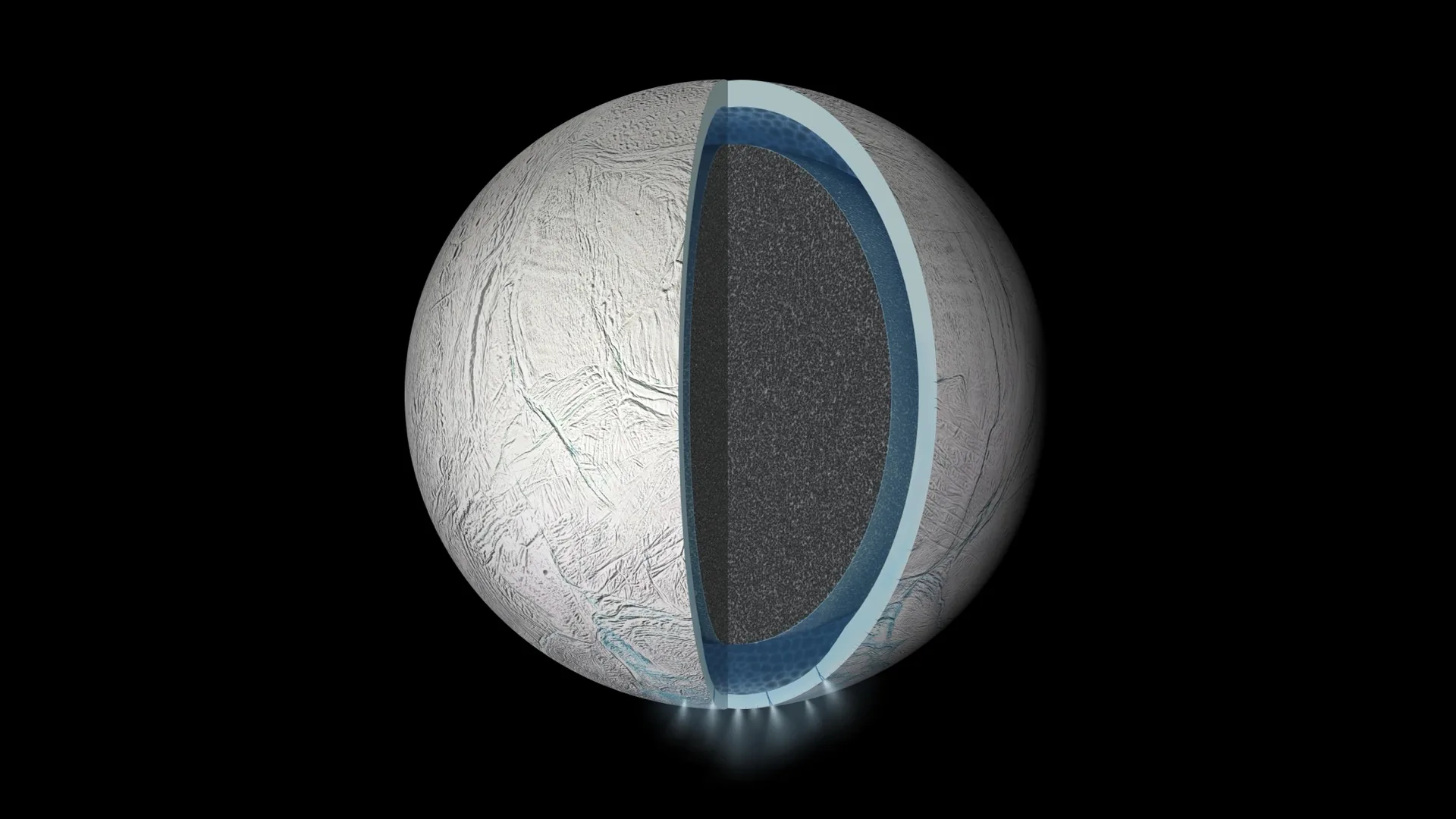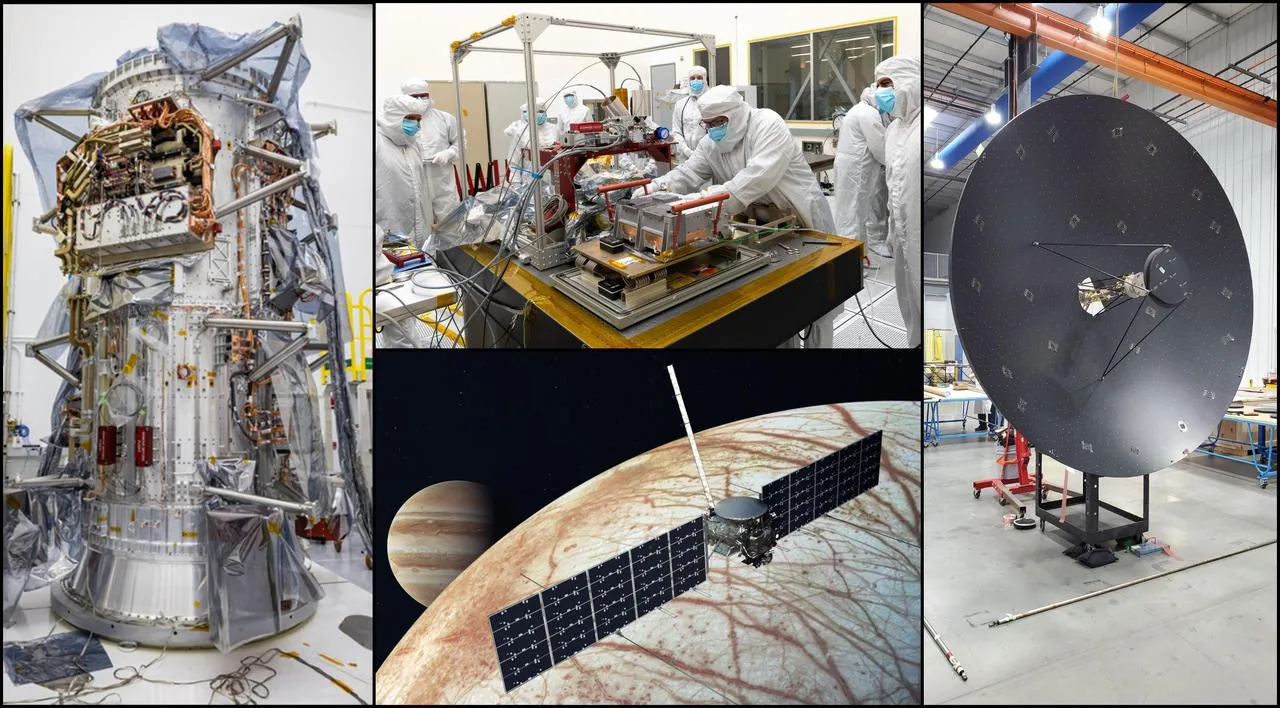
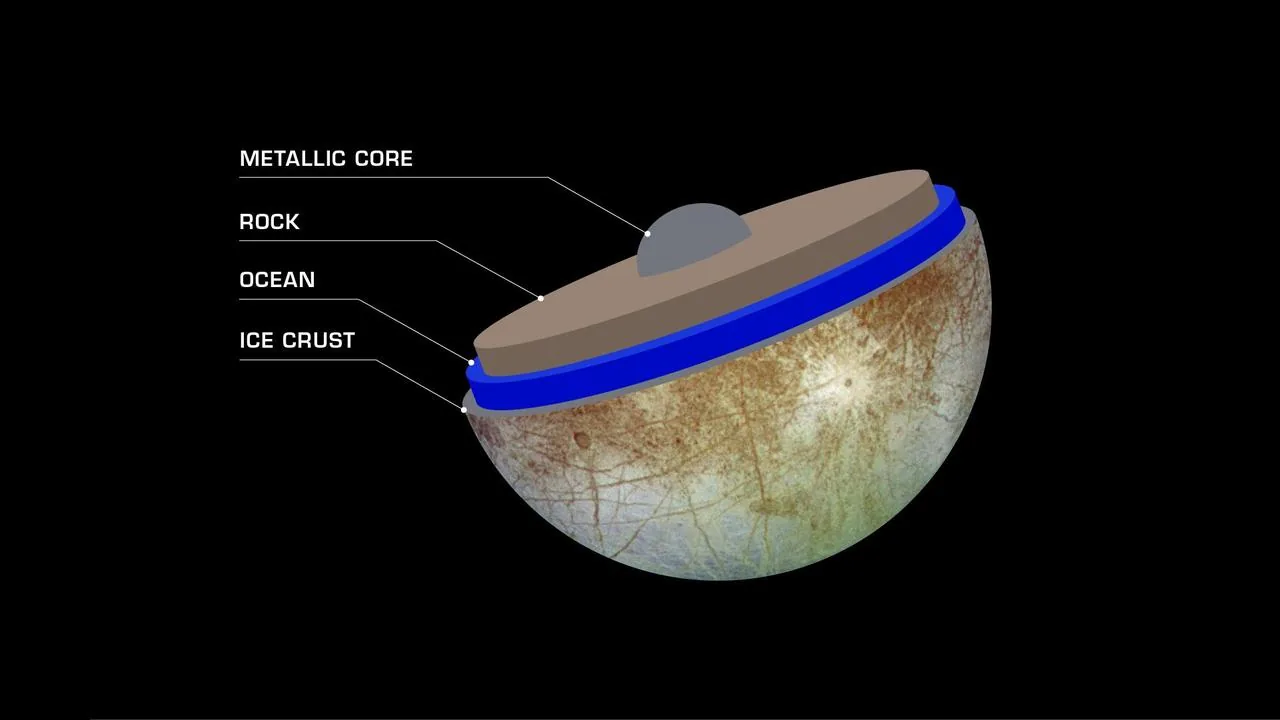
On October 14, 2024, a SpaceX Falcon Heavy rocket roared off the pad at Kennedy Space Center, carrying the largest spacecraft NASA has ever built for a planetary mission. Its destination: Jupiter's ice-covered moon Europa, a world slightly smaller than our own Moon but harboring a secret that has captivated scientists for decades. Beneath Europa's cracked and frozen shell lies a vast saltwater ocean, containing roughly twice the volume of all Earth's oceans combined. And where there is liquid water, energy, and chemistry, there just might be life.
Europa Clipper is not just another space probe. It represents humanity's most ambitious and carefully designed attempt to determine whether another world in our solar system has the conditions necessary for life. The stakes could not be higher. If Europa's ocean is habitable, it will transform our understanding of biology, our place in the cosmos, and where we look for life across the galaxy.
Why Europa?
The story of Europa as an astrobiological target begins with the Voyager flybys of the late 1970s and early 1980s. Those twin spacecraft sent back images of a strangely smooth, bright world crisscrossed with reddish-brown streaks and fractures. Unlike the heavily cratered surfaces of most moons, Europa's face was remarkably young, suggesting active geological processes were constantly resurfacing it.
Then came Galileo. NASA's Galileo orbiter studied the Jupiter system from 1995 to 2003, and its findings about Europa were revolutionary. Magnetometer data revealed that Europa's interior responded to Jupiter's rotating magnetic field in a way that could only be explained by a global layer of electrically conductive fluid, a saltwater ocean, beneath the ice. The surface fractures and chaotic terrain hinted at ice shell dynamics driven by tidal heating from Jupiter's enormous gravitational pull. Reddish-brown material along the cracks suggested salts and possibly organic compounds welling up from below.
The case for Europa's ocean has only strengthened since then. Hubble Space Telescope observations in the 2010s detected what appeared to be water vapor plumes erupting from the surface, similar to the geysers seen on Saturn's moon Enceladus. If confirmed, these plumes would mean that ocean material is being delivered directly to the surface and into space, potentially accessible to a spacecraft without drilling through miles of ice.
The Spacecraft
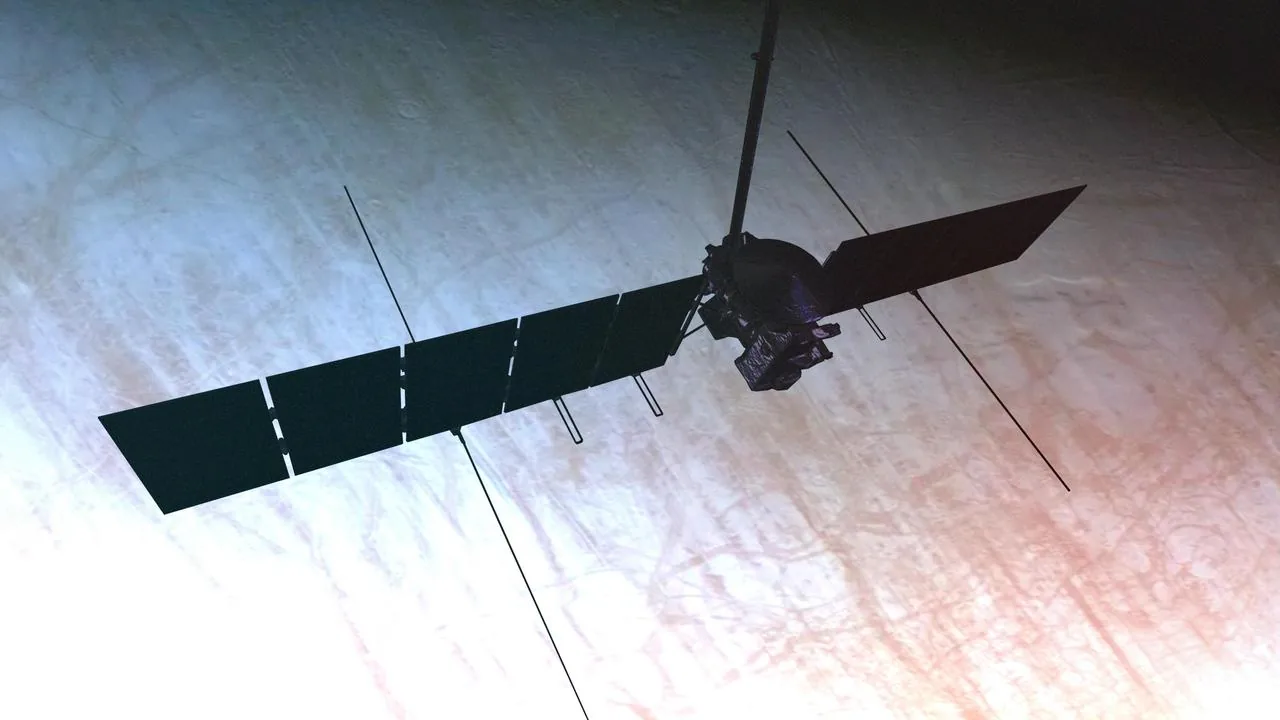
Europa Clipper is a marvel of engineering. With its solar arrays deployed, it spans over 30 meters, roughly the size of a basketball court. This enormous surface area is necessary because Jupiter is five times farther from the Sun than Earth, and sunlight there is only about four percent as intense. Those massive solar panels will generate the roughly 700 watts of power needed to run the spacecraft's nine science instruments.
The choice of solar power over a traditional nuclear power source (a radioisotope thermoelectric generator) was both practical and political. The global supply of plutonium-238, the fuel used in RTGs, is limited and prioritized for missions where solar power is not feasible. Europa Clipper's designers proved that modern high-efficiency solar cells could do the job even at Jupiter's distance.
The spacecraft carries a suite of instruments designed to work together as a comprehensive investigation toolkit. Each one addresses a different piece of the habitability puzzle.
REASON (Radar for Europa Assessment and Sounding: Ocean to Near-surface) is an ice-penetrating radar that will peer through Europa's frozen crust. By sending radio waves into the ice and listening for reflections from internal layers, it can map the ice shell's structure and potentially detect pockets of liquid water within the shell itself. Understanding the ice shell's thickness and architecture is crucial for determining whether ocean material can reach the surface.
Europa Imaging System (EIS) will photograph the surface at resolutions up to 0.5 meters per pixel, better than we have ever seen Europa. These images will reveal the fine-scale geology of the cracks, ridges, and chaos regions, helping scientists understand how the surface connects to the ocean below.
MASPEX (Mass Spectrometer for Planetary Exploration) and SUDA (Surface Dust Analyzer) will sample any material ejected from Europa, whether from plumes or from surface sputtering caused by Jupiter's intense radiation. These instruments can identify organic molecules, salts, and other compounds that would reveal the ocean's chemistry.
E-THEMIS (Europa Thermal Emission Imaging System) will map surface temperatures, identifying warm spots that might indicate recent or ongoing geological activity such as plume vents or areas of thin ice.
Additional instruments will study Europa's magnetic field, gravity field, and ultraviolet emissions, each contributing another piece to the habitability puzzle.
The Flyby Strategy
Europa Clipper will not orbit Europa. Jupiter's radiation environment near Europa is so intense that it would fry the spacecraft's electronics within weeks of entering Europa orbit. Instead, the mission employs a clever strategy: it will orbit Jupiter on a long, looping path and make repeated close flybys of Europa, dipping in and out of the worst radiation zones.
Over the course of its primary mission, Europa Clipper will perform 49 planned flybys of the moon, each time passing at a different angle and altitude to build up global coverage. Some passes will bring the spacecraft within just 25 kilometers of the surface. Between flybys, the spacecraft retreats to the relative safety of the outer Jupiter system to transmit data back to Earth and recover from radiation exposure.
This approach has been proven effective. Galileo made only 12 flybys of Europa and still produced groundbreaking science. With 49 passes and far superior instruments, Europa Clipper will achieve coverage and resolution that Galileo's team could only dream of.
The Long Road to Jupiter
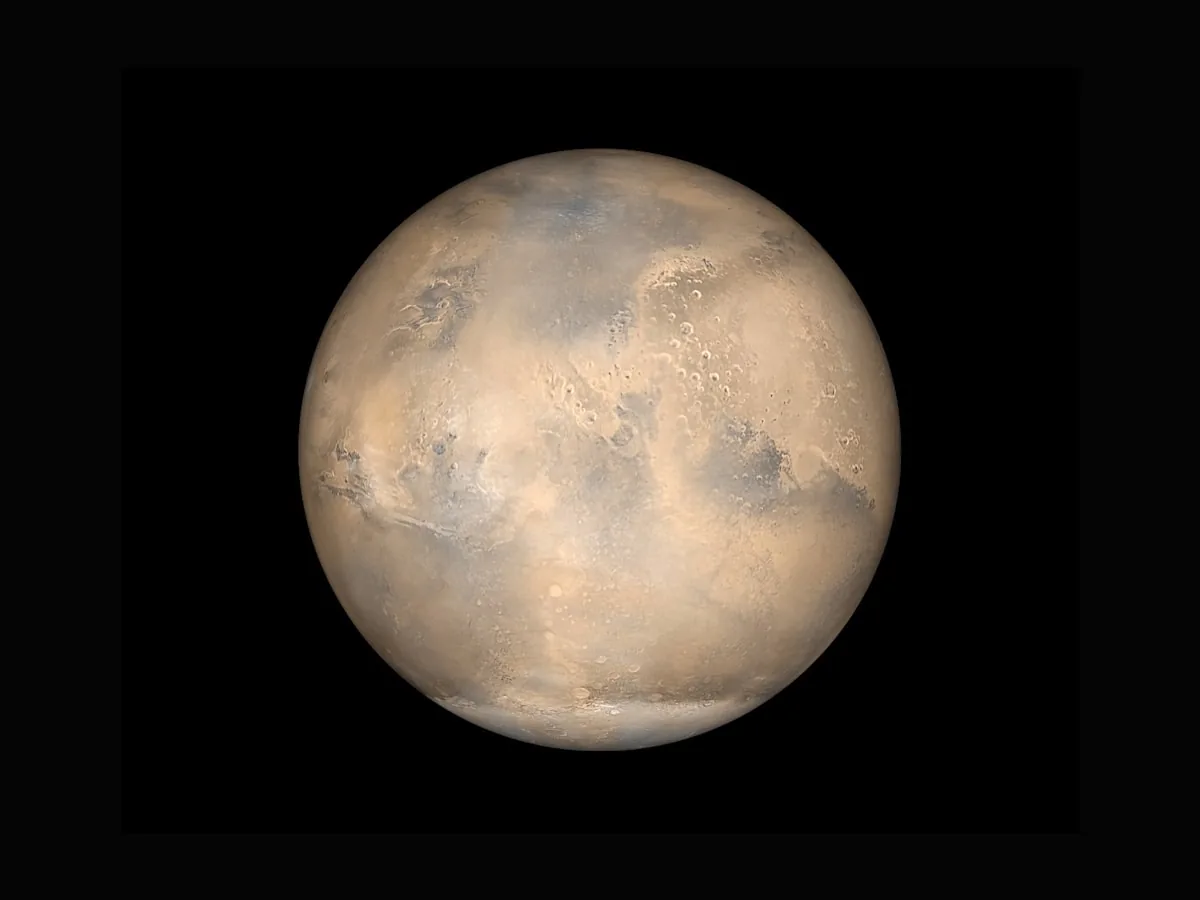
Europa Clipper is currently on a journey that will take nearly six years. The spacecraft will perform gravity assists, using the gravitational pull of Mars (in March 2025) and Earth (in December 2026) to gain the speed necessary to reach Jupiter. It will arrive in the Jovian system in April 2030.
After arrival, the spacecraft will spend several months adjusting its orbit before beginning its Europa flyby campaign. The primary science mission is planned to last about three and a half years, with potential extensions if the spacecraft remains healthy.
The long cruise phase is not wasted time. Engineers will use it to thoroughly test and calibrate every instrument, update the flight software, and fine-tune the observation plans based on any new discoveries made by other telescopes or missions in the interim.
What We Hope to Find
Europa Clipper is designed to answer three fundamental questions: Does Europa have an ocean? Is that ocean habitable? And is there evidence of active geology that could sustain habitable conditions?
The first question is largely answered, we are confident the ocean exists, but Europa Clipper will characterize it in unprecedented detail. How thick is the ice shell? How deep is the ocean? What is the ocean's salinity and pH? Is there a rocky seafloor where water-rock interactions could provide the chemical energy that life needs?
The habitability question is more nuanced. Life as we know it requires liquid water, a source of energy, and the right chemical ingredients (carbon, hydrogen, nitrogen, oxygen, phosphorus, and sulfur, collectively known as CHNOPS). Europa almost certainly has the water. Tidal heating provides energy. The presence of salts and possibly organic compounds on the surface suggests the chemistry could be right. But the devil is in the details, and Europa Clipper will provide those details.
If the spacecraft detects complex organic molecules in plume material or surface deposits, that would be electrifying. If it finds evidence of hydrothermal activity on the ocean floor, that would strengthen the analogy with Earth's deep-sea hydrothermal vents, environments that support thriving ecosystems entirely independent of sunlight.
It is important to be clear about what Europa Clipper will not do: it will not definitively detect life. The spacecraft is not equipped with life-detection instruments in the traditional sense. It is designed to determine whether Europa's ocean is a place where life could exist. Confirming the actual presence of organisms would likely require a future mission, perhaps a lander that could sample the surface or even a submarine that could penetrate the ice.
A Mission Decades in the Making
Europa Clipper's journey to the launchpad was nearly as epic as its journey to Jupiter. Scientists first proposed a dedicated Europa mission in the late 1990s, inspired by Galileo's discoveries. The concept went through multiple iterations: Europa Orbiter, Jupiter Icy Moons Orbiter, and various versions of what eventually became Europa Clipper. Budget battles, technical challenges, and shifting priorities delayed the mission for over two decades.
The persistence of the scientific community, and the support of key advocates in Congress, finally prevailed. Europa Clipper was formally approved in 2015, and its development became one of NASA's flagship planetary science efforts. The total mission cost is approximately five billion dollars, a substantial investment that reflects both the technical difficulty and the scientific importance of the endeavor.
Looking Ahead
As Europa Clipper cruises silently through the inner solar system, gathering speed for its rendezvous with Jupiter, the anticipation among planetary scientists is palpable. This is the mission many of them have spent their entire careers working toward. The data it returns could reshape astrobiology, or it could tell us that Europa's ocean, while impressive, lacks the conditions for life. Either answer would be profoundly important.
If Europa Clipper finds that the ocean is habitable, the pressure to send a follow-up mission will be immense. Concepts for Europa landers and even ice-penetrating probes are already being studied. The dream of one day sampling Europa's ocean directly is no longer science fiction. It is engineering, waiting for its turn.
For now, we wait, we watch, and we wonder. Somewhere beyond Mars, a basketball-court-sized spacecraft is carrying our questions toward a frozen moon with a hidden ocean. The answers begin arriving in 2030.