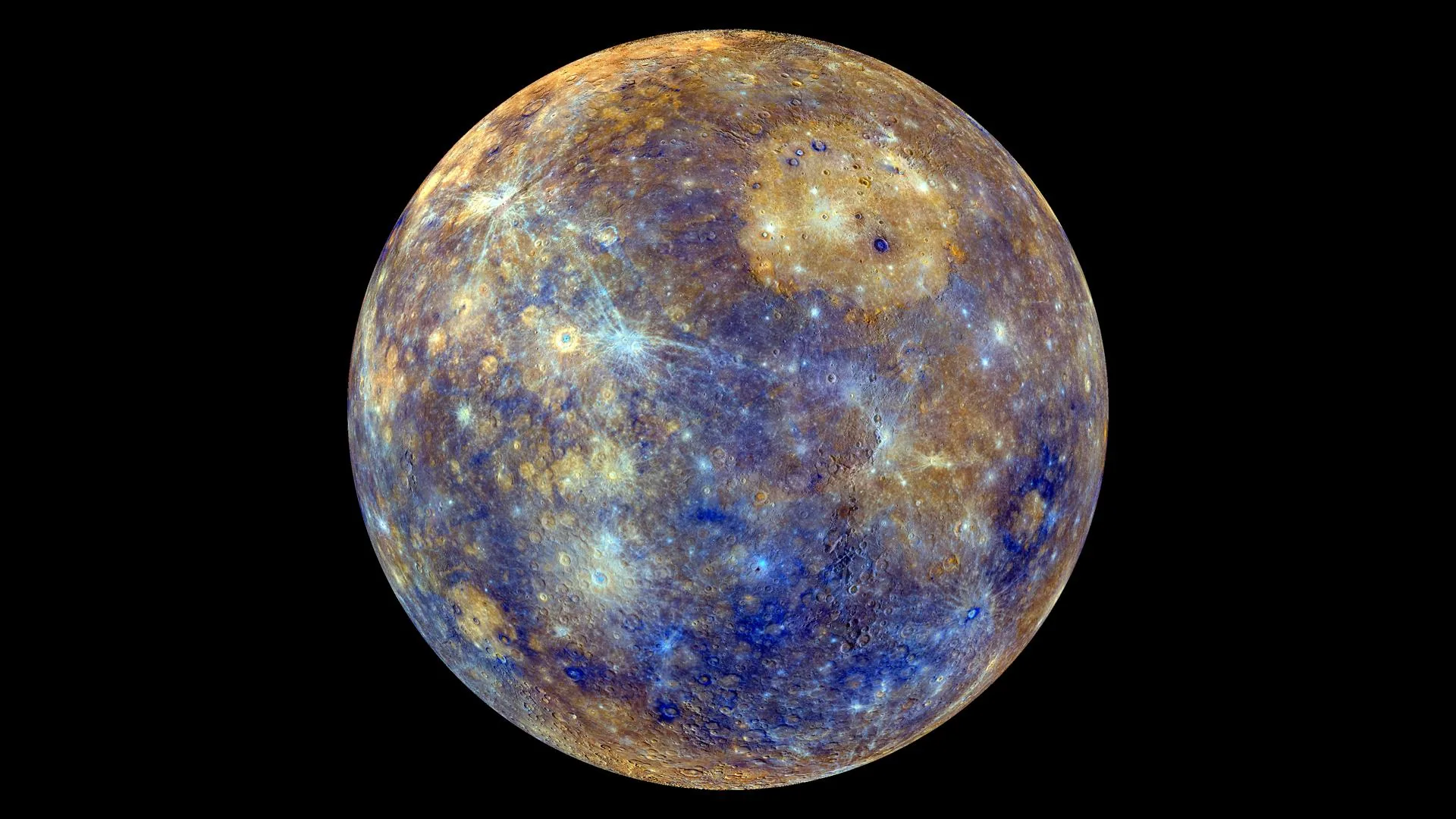
Mercury is a world of extremes and contradictions. It is the smallest planet in the solar system, barely larger than Earth's Moon, yet it possesses a massive iron core that accounts for roughly 85 percent of its radius. Its surface bakes at temperatures exceeding 430 degrees Celsius on the sunlit side while plunging to minus 180 degrees Celsius in the shadows -- and yet confirmed deposits of water ice sit undisturbed in permanently darkened craters at its poles. It is the closest planet to the Sun, visible to the naked eye since antiquity, and somehow one of the least understood worlds in our cosmic neighborhood.
That is about to change. The European-Japanese BepiColombo mission, after a journey of more than seven years and six gravity-assist flybys of Mercury itself, is preparing to enter orbit around the innermost planet in late 2026. When it does, it will deploy the most sophisticated suite of instruments ever brought to bear on Mercury, promising to rewrite our understanding of how rocky planets form and evolve. But to appreciate what BepiColombo will accomplish, you first need to understand why Mercury has been so stubbornly difficult to explore -- and what the missions that came before it managed to reveal.
The Problem With Getting to Mercury
On paper, Mercury seems like it should be an easy target. It is relatively close -- at its nearest, only about 77 million kilometers from Earth, closer than Mars at opposition. But orbital mechanics does not care about straight-line distances, and reaching Mercury is one of the most demanding challenges in interplanetary navigation.
The fundamental problem is the Sun's gravity. A spacecraft leaving Earth is already moving at roughly 30 kilometers per second in its orbit around the Sun. To reach Mercury, which orbits at an average distance of 57.9 million kilometers from the Sun, a probe must shed a tremendous amount of orbital energy to fall inward. Counterintuitively, it takes more energy to reach Mercury from Earth than it does to reach Jupiter. A direct transfer would require an impractical amount of fuel, so every Mercury mission has relied on elaborate sequences of planetary flybys -- using the gravity of Earth, Venus, and Mercury itself to gradually slow down over the course of years.
Then there is the thermal environment. Mercury's proximity to the Sun means that any spacecraft operating there faces solar radiation roughly eleven times more intense than what satellites experience in Earth orbit. The sunlit side of a Mercury orbiter must withstand searing heat while its shaded instruments remain cold enough to function. Engineering a spacecraft that can survive this thermal gradient for years is an extraordinarily difficult design problem.
Finally, there is the matter of orbital insertion. A spacecraft approaching Mercury is accelerating under the Sun's powerful gravitational pull. To enter a stable orbit rather than shooting past the planet or falling into the Sun, it must execute a precisely timed braking maneuver. Mercury's low mass -- just 5.5 percent of Earth's -- means its gravitational capture zone is small, leaving very little margin for error. Every Mercury mission has been a masterclass in precision astrodynamics.
Mariner 10: The Pioneer (1973-1975)
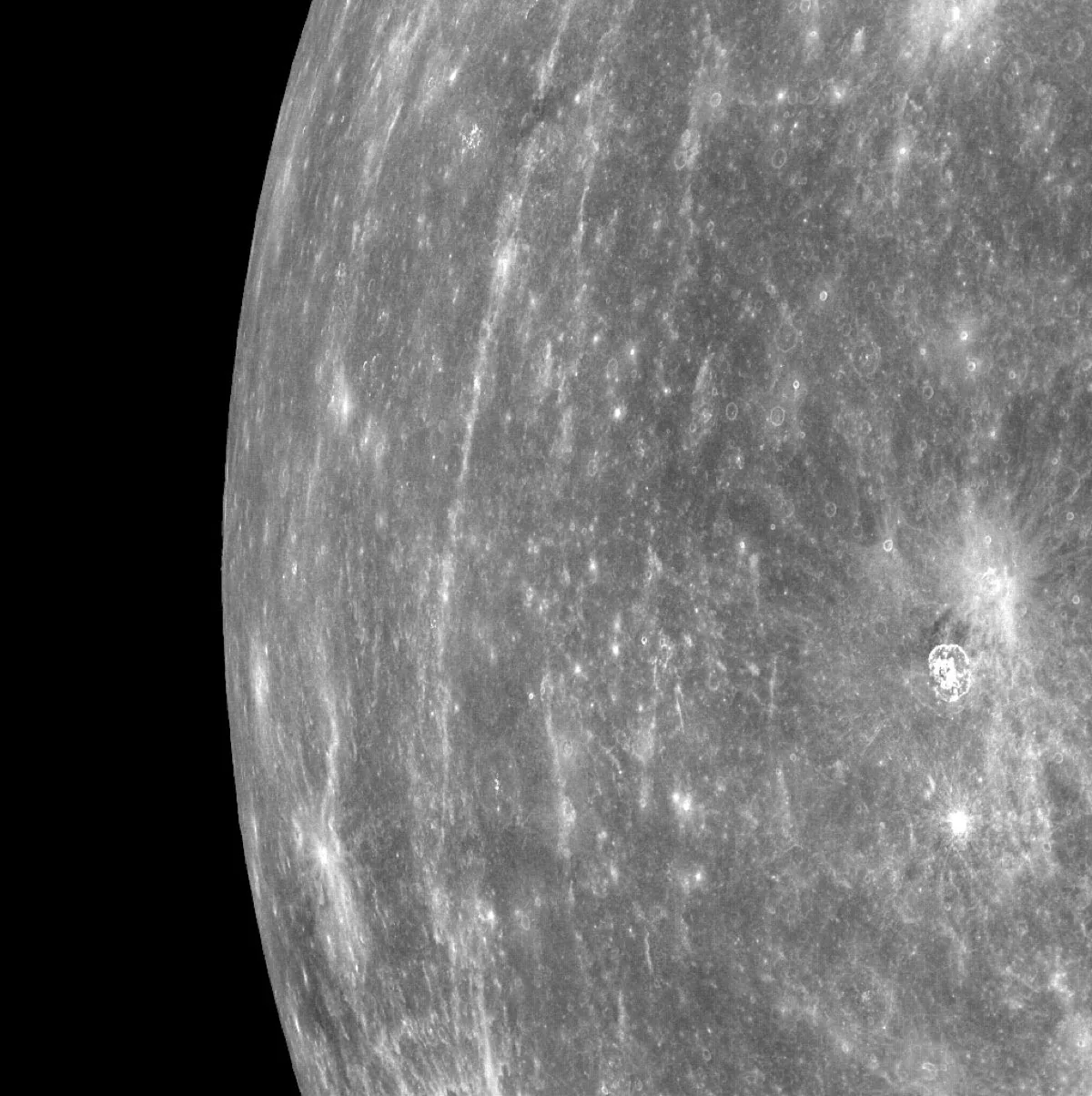
For decades after the dawn of the Space Age, Mercury remained unexplored. That changed on November 3, 1973, when NASA launched Mariner 10 from Cape Canaveral atop an Atlas-Centaur rocket. Mariner 10 was a groundbreaking mission in several respects. It was the first spacecraft to use a gravity assist from one planet to reach another, swinging past Venus on February 5, 1974, and using that encounter to bend its trajectory toward Mercury. It was also the first -- and for thirty years, the only -- spacecraft to visit the innermost planet.
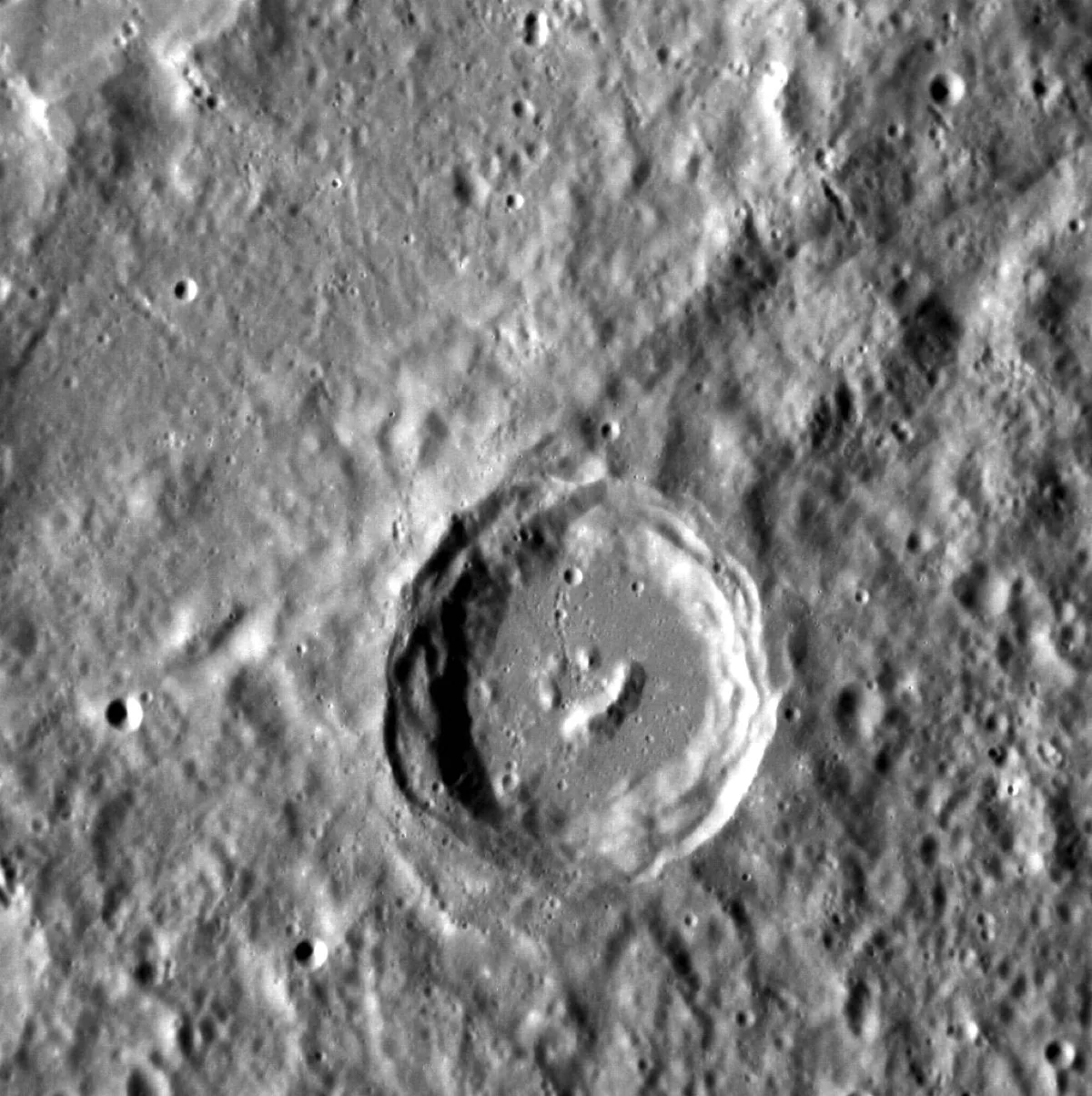
Mariner 10 made three flybys of Mercury: on March 29, 1974; September 21, 1974; and March 16, 1975. During these encounters, the spacecraft passed within 327 kilometers of the surface at closest approach and returned more than 2,800 photographs covering approximately 45 percent of Mercury's surface. The images revealed a heavily cratered landscape superficially resembling the Moon, dominated by the enormous Caloris Basin -- an impact structure roughly 1,550 kilometers across, one of the largest in the solar system.
But Mariner 10's most startling discovery was Mercury's magnetic field. Before the mission, most scientists expected Mercury to have no global magnetic field at all. The planet is small, it rotates extremely slowly -- once every 58.6 Earth days -- and conventional dynamo theory suggested its iron core should have solidified long ago, shutting down any field-generating mechanism. Yet Mariner 10's magnetometer detected a dipolar magnetic field, weak but unmistakable, about one percent the strength of Earth's. This finding posed a puzzle that would take decades to unravel and remains an active area of research today.
Mariner 10 also measured Mercury's surface temperatures, confirmed its negligible atmosphere (technically an "exosphere" of atoms blasted off the surface by solar wind and micrometeorite impacts), and refined estimates of the planet's mass and density. The density figure was particularly striking: at 5,427 kilograms per cubic meter, Mercury is the second densest planet in the solar system after Earth. When corrected for gravitational compression -- Earth's greater mass squeezes its interior more tightly -- Mercury is actually the densest planet, period. Something about its formation or early evolution had left it with a wildly outsized iron core.
After its third flyby, Mariner 10 exhausted its attitude control gas and was shut down on March 24, 1975. It had mapped less than half the planet, and the other half remained terra incognita. Mercury would wait nearly three decades for its next visitor.
MESSENGER: Rewriting the Textbook (2004-2015)
NASA's MESSENGER mission -- an acronym for MErcury Surface, Space ENvironment, GEochemistry, and Ranging -- launched on August 3, 2004, from Cape Canaveral. Getting to Mercury required an epic voyage: one flyby of Earth, two of Venus, and three of Mercury over the course of six and a half years before the spacecraft finally entered orbit on March 18, 2011. MESSENGER became the first spacecraft to orbit Mercury, and over the next four years, it revolutionized our understanding of the planet.
MESSENGER carried seven scientific instruments and a radio science experiment. Its orbital campaign mapped Mercury's entire surface in high resolution for the first time, revealing a world far more complex and geologically diverse than the cratered wasteland Mariner 10 had suggested.
Water Ice at the Poles
Perhaps MESSENGER's most celebrated discovery was the confirmation of water ice at Mercury's poles. Earth-based radar observations in 1991 had detected highly reflective deposits in Mercury's polar regions, and scientists had speculated they might be ice. MESSENGER proved it. The spacecraft's neutron spectrometer detected hydrogen-rich deposits consistent with water ice in permanently shadowed craters at both the north and south poles. Its laser altimeter mapped these craters in detail, showing that ice deposits correlated precisely with regions that never receive direct sunlight due to Mercury's nearly zero axial tilt (just 0.034 degrees, compared to Earth's 23.4 degrees).
The ice is estimated to be up to 3 meters thick in some craters and is covered in many locations by a thin layer of dark organic-rich material. The total amount of water ice at Mercury's poles may be between 100 billion and one trillion metric tons. It was almost certainly delivered by comets and water-rich asteroids over billions of years and has survived in these frozen shadow traps where temperatures remain below minus 170 degrees Celsius despite Mercury's proximity to the Sun.
Volcanic Plains and Geological Surprises
MESSENGER revealed that vast swaths of Mercury's surface are covered by ancient volcanic plains, some of which are billions of years old. The northern lowlands, in particular, were found to be a massive expanse of smooth volcanic terrain -- evidence that Mercury experienced widespread volcanism early in its history. The spacecraft also discovered features called "hollows" -- irregular, shallow depressions with bright interiors and halos, found across the planet but concentrated on crater floors and central peaks. Hollows appear to be geologically young, possibly still forming today, created by the sublimation or breakdown of volatile-bearing minerals exposed to Mercury's harsh surface conditions. Nothing quite like them exists elsewhere in the solar system.
The Magnetic Field and Core
MESSENGER's magnetometer confirmed Mercury's global dipolar magnetic field and revealed that it is offset significantly to the north -- the magnetic equator sits roughly 480 kilometers north of the geographic equator. This asymmetry means the southern hemisphere is more exposed to the solar wind, which may explain differences in surface weathering between the two hemispheres.
Gravity measurements and libration data from MESSENGER confirmed that Mercury has a large, partially liquid outer core. This was the key insight for understanding the magnetic field: the core has not fully solidified, and a dynamo process in the liquid iron layer can sustain a weak field. The solid inner core is estimated to be roughly 2,000 kilometers in diameter -- enormous relative to the planet's total diameter of 4,880 kilometers. Mercury is, in essence, a giant iron ball with a thin silicate shell.
The End of MESSENGER
By early 2015, MESSENGER was running critically low on fuel. Mission controllers executed a series of orbit-raising maneuvers to extend the mission, but gravity inevitably won. On April 30, 2015, MESSENGER impacted Mercury's surface at a speed of roughly 3.91 kilometers per second, creating a new crater estimated at 16 meters across. It had transmitted more than 277,000 images and returned ten terabytes of scientific data. The mission answered many questions but, as great science missions do, raised many more.
BepiColombo: The Most Ambitious Mercury Mission Yet
BepiColombo is a joint mission of the European Space Agency (ESA) and the Japan Aerospace Exploration Agency (JAXA), named after the Italian mathematician and engineer Giuseppe "Bepi" Colombo, who devised the gravity-assist trajectory that made Mariner 10's Mercury flybys possible. The mission launched on October 20, 2018, from the Guiana Space Centre in Kourou, French Guiana, atop an Ariane 5 rocket.
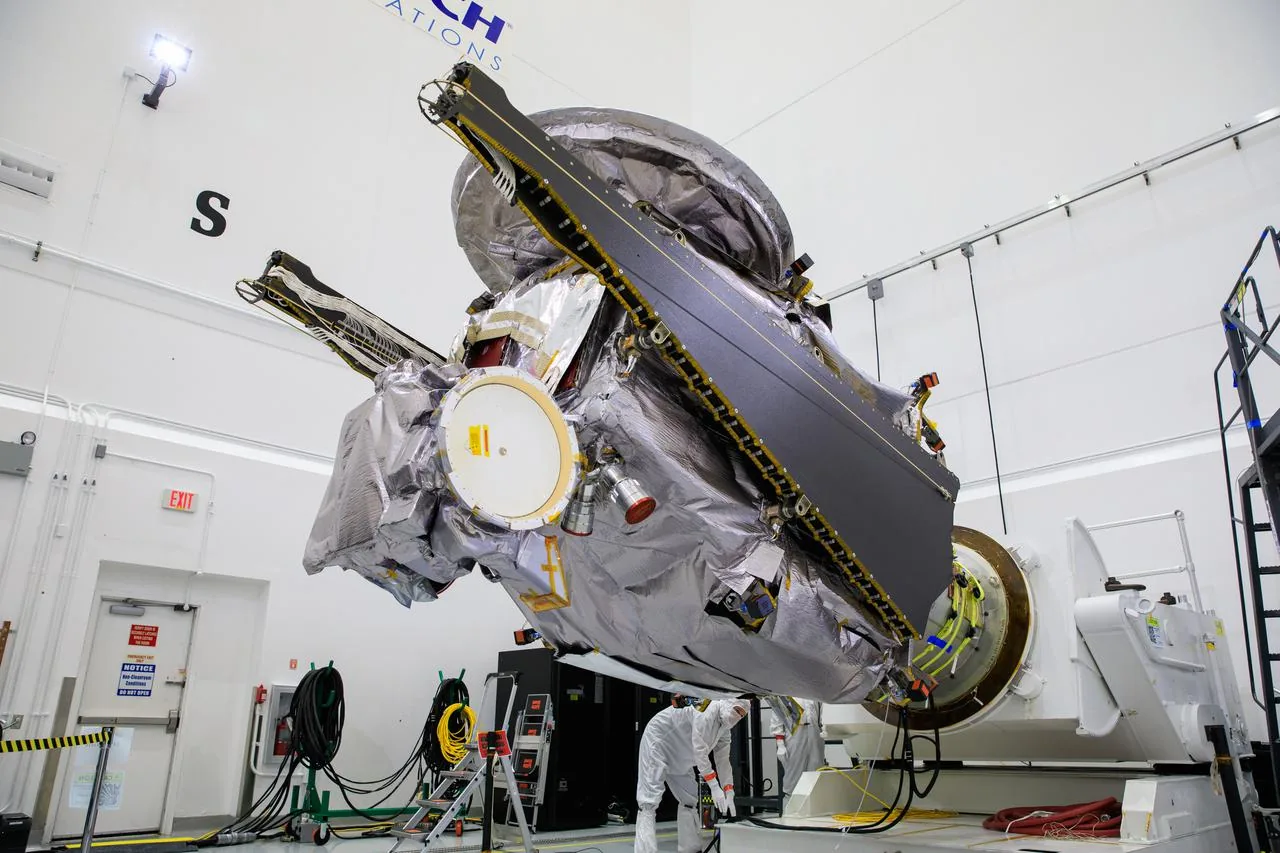
The spacecraft is actually a composite of three components traveling together during the cruise phase. The Mercury Planetary Orbiter (MPO), built by ESA, carries eleven instruments focused on surface and internal structure studies. The Mercury Magnetospheric Orbiter (Mio), built by JAXA, carries five instruments designed to study Mercury's magnetic field, magnetosphere, and exosphere. The Mercury Transfer Module (MTM), which provides solar-electric propulsion during the cruise phase, will be jettisoned before orbital insertion.
The Long Road to Mercury
BepiColombo's journey to Mercury has been one of the most complex ever flown. The spacecraft has executed nine planetary gravity assists: one of Earth (April 2020), two of Venus (October 2020 and August 2021), and six of Mercury (October 2021, June 2022, June 2023, September 2024, December 2024, and January 2025). Each flyby has served a dual purpose: adjusting the spacecraft's trajectory for eventual orbital insertion, and providing tantalizing previews of Mercury's surface and environment.
During its Mercury flybys, BepiColombo's instruments -- though constrained by the cruise configuration, which limits which sensors can be pointed at the planet -- have already returned valuable data. The flybys have captured close-up images of previously unseen terrain, detected ions in Mercury's exosphere, and measured the magnetic field at different locations and times. The September 2024 flyby brought the spacecraft within approximately 165 kilometers of the surface, the closest of all the flyby encounters.
What Makes BepiColombo Different
BepiColombo represents a generational leap over MESSENGER in several ways. First, it deploys two orbiters rather than one, enabling simultaneous measurements of Mercury's surface and magnetosphere -- something no previous mission could do. The MPO will operate in a polar orbit ranging from 480 to 1,500 kilometers altitude, while Mio will occupy a more elliptical polar orbit from 590 to 11,640 kilometers, sweeping through different regions of the magnetosphere.
Second, BepiColombo's instrument suite is far more capable than MESSENGER's. The MPO carries a laser altimeter (BELA) that will map Mercury's topography with unprecedented precision, a thermal infrared spectrometer (MERTIS) to study surface composition and mineralogy, an X-ray spectrometer (MIXS) to identify elemental composition, and a suite of cameras, accelerometers, and radio science experiments. Mio carries ion and electron analyzers, a magnetometer, a plasma wave instrument, and a sodium imager -- the first dedicated instrument to study Mercury's enigmatic sodium exosphere in detail.
Third, BepiColombo's orbit will be more stable and longer-lived than MESSENGER's, which had to contend with severe orbital perturbations from the Sun's gravity. The mission's nominal science phase is planned for one Earth year (roughly four Mercury years), with a possible one-year extension.
Mercury's Enduring Mysteries
Despite what Mariner 10 and MESSENGER revealed, Mercury remains deeply enigmatic. Several fundamental questions about the planet have no satisfactory answers, and they go to the heart of how the solar system formed.
The Core Problem
Mercury's iron core is far too large for a planet its size. If Mercury had formed from the same primordial material as the other terrestrial planets and differentiated normally, its core should be proportionally much smaller. Several hypotheses have been proposed. The "giant impact" model suggests that a massive collision early in Mercury's history stripped away most of its silicate mantle, leaving behind the iron-dominated remnant we see today. An alternative hypothesis proposes that the intense solar radiation near the young Sun vaporized lighter silicate materials during Mercury's formation, preferentially accumulating denser iron-rich particles. A third idea invokes chemical sorting in the early solar nebula. None of these models is entirely satisfactory, and each makes different predictions about Mercury's composition that BepiColombo's instruments are designed to test.
The Magnetic Field Puzzle
Mercury's magnetic field, while confirmed as a global dipolar field generated by a core dynamo, remains poorly understood in detail. Why is it so weak -- roughly one percent of Earth's field strength? Why is it so strongly offset to the north? What role does the solid inner core play in the dynamo process? MESSENGER's measurements provided vital constraints, but the spacecraft could only measure the field from one platform at one altitude. BepiColombo's dual-orbiter architecture will allow simultaneous measurements at different altitudes and locations, disentangling internal field sources from external magnetospheric currents for the first time.
Hollows and Volatiles
Mercury's hollows remain one of the most intriguing geological features discovered anywhere in the solar system. These irregular, flat-floored depressions, typically tens of meters deep and ranging from meters to kilometers across, appear bright and fresh -- geologically speaking, they may be actively forming today. Their formation mechanism is not fully understood, but it appears to involve the loss of volatile materials from the surface, possibly through sublimation, sputtering by solar wind particles, or photon-stimulated desorption.
The very existence of hollows challenges the old view of Mercury as a volatile-depleted world. MESSENGER's X-ray and gamma-ray spectrometers detected unexpectedly high abundances of volatile elements like sulfur, potassium, and sodium on Mercury's surface -- elements that should have been driven off long ago if any of the simple formation models were correct. Understanding Mercury's volatile inventory is one of BepiColombo's highest science priorities.
The Exosphere
Mercury has no true atmosphere, but it does have an exosphere -- an incredibly thin envelope of atoms and ions gravitationally bound to the planet but so sparse that individual particles almost never collide with one another. The exosphere contains sodium, calcium, magnesium, potassium, and other elements, blasted off the surface by solar wind impacts, ultraviolet photon bombardment, and micrometeorite strikes. The exosphere is highly dynamic, varying with Mercury's position in its eccentric orbit (which ranges from 46 to 70 million kilometers from the Sun) and responding to solar wind conditions. MESSENGER studied the exosphere extensively, but many questions remain about the source and loss processes that maintain it. Mio's dedicated sodium imager and particle instruments will monitor the exosphere continuously, tracking its response to solar activity in real time.
What BepiColombo Will Answer
When BepiColombo's two orbiters begin their science operations -- expected in early 2027 after a commissioning phase following the late 2026 orbital insertion -- they will tackle a set of questions that span planetary science, geophysics, and fundamental physics.
The MPO will produce the most detailed global maps of Mercury's surface composition ever made, identifying minerals and elements at a resolution MESSENGER could not achieve. Its thermal infrared spectrometer will map surface mineralogy for the first time, potentially distinguishing between the competing formation models by revealing whether Mercury's silicate shell has the composition predicted by the giant impact scenario, the solar vaporization model, or something else entirely.
The dual-orbiter measurements of the magnetic field will produce the first three-dimensional model of Mercury's magnetosphere and its interaction with the solar wind. By separating internal and external field contributions, scientists will be able to place much tighter constraints on the state and dynamics of Mercury's liquid core, the size of its solid inner core, and the nature of the dynamo process.
BepiColombo will also conduct the most precise test of general relativity in the inner solar system. By tracking the spacecraft's orbit with extraordinary accuracy using radio science techniques, scientists will measure Mercury's orbital precession and gravitational field to test Einstein's theory in the strong-gravity regime near the Sun. Colombo himself would have appreciated the elegance of this experiment.
The laser altimeter will produce a global topographic map of Mercury with meter-scale vertical resolution, revealing tectonic features, volcanic landforms, and impact structures in unprecedented detail. Combined with gravity data, this will allow scientists to probe Mercury's internal structure -- the thickness of its crust, the properties of its mantle, and the shape of its core-mantle boundary.
And Mio, sweeping through the magnetosphere in its elliptical orbit, will monitor the solar wind interaction, magnetic reconnection events, and particle acceleration processes that shape Mercury's space environment. These measurements will shed light on how unmagnetized and weakly magnetized bodies interact with the solar wind -- a question relevant not only to Mercury but to exoplanets orbiting close to their host stars.
A Planet That Challenges What We Know
Mercury's story is, in many ways, the story of planetary science itself -- a discipline that has repeatedly discovered that the solar system is stranger, more complex, and more beautiful than anyone imagined. Every mission to Mercury has overturned assumptions. Mariner 10 found a magnetic field that should not have existed. MESSENGER found water ice on the hottest planet, volatiles on a world thought to be depleted, and geological activity on a surface presumed dead.
BepiColombo arrives at Mercury carrying the accumulated questions of fifty years of exploration and the most advanced instruments ever sent to the inner solar system. The innermost planet has held its secrets longer than almost any other world. That era is ending. What BepiColombo finds in orbit around Mercury may reshape not only our understanding of this small, scorched world but our models of how all rocky planets -- including our own -- came to be.