Europe's space agency has been quietly -- and sometimes not so quietly -- having one of the most productive periods in its history. From launching a brand-new rocket to dispatching missions toward Jupiter, asteroids, and the dark fabric of the universe itself, ESA has reminded the world that European space science and engineering operate at the absolute frontier. For those of us who follow space closely, the last two years have been a feast.
Let's dig into what has made 2023-2025 such a remarkable stretch for the European Space Agency.
Ariane 6: Europe Reclaims Independent Launch Access
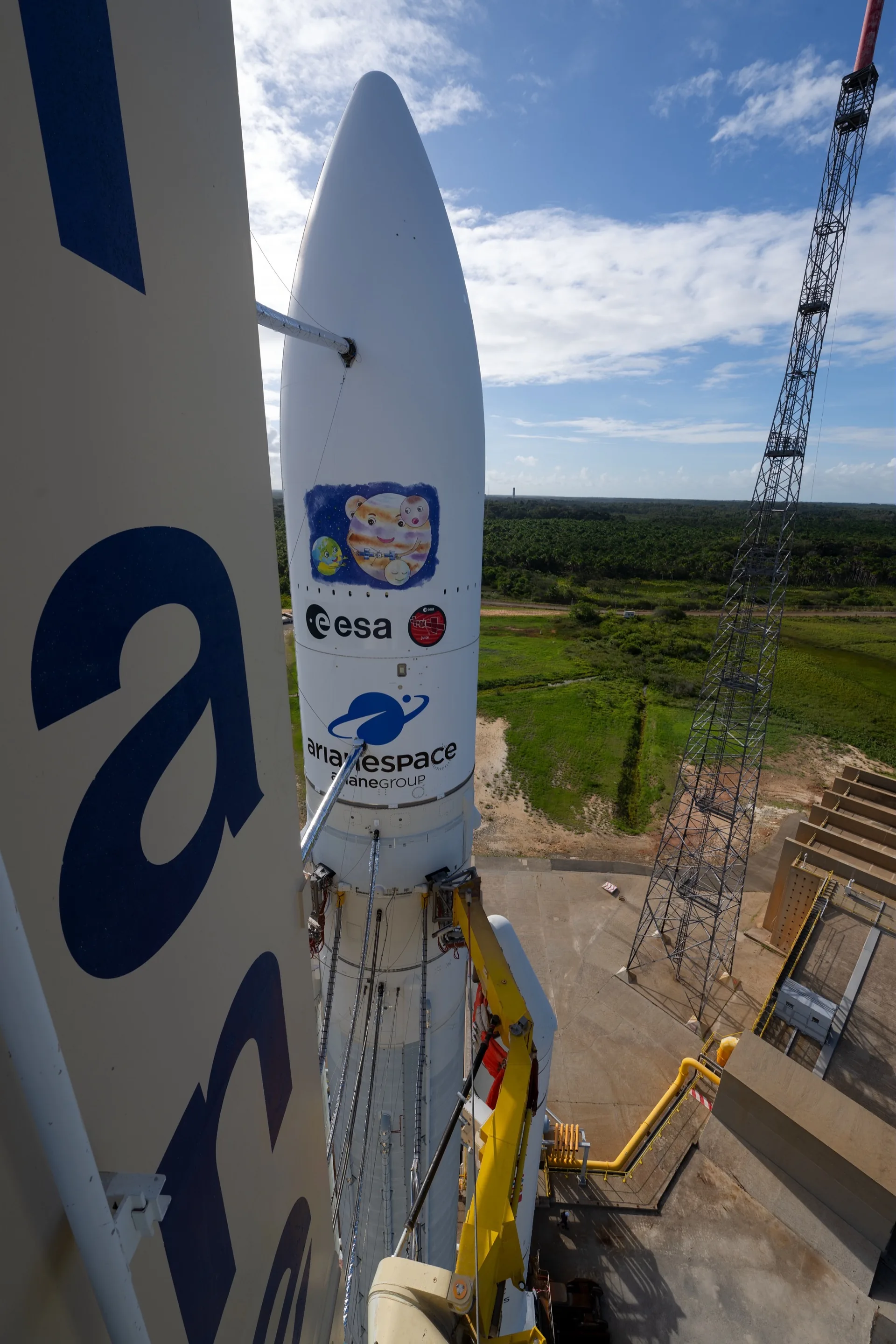
The story of Ariane 6 is one of perseverance. Europe's next-generation heavy-lift rocket completed its inaugural flight on July 9, 2024, lifting off from the Guiana Space Centre in Kourou, French Guiana. After years of development delays -- compounded by the retirement of Ariane 5 in July 2023 and the geopolitical fallout that cut off European access to Russian Soyuz rockets -- the pressure on Ariane 6 to deliver was immense.
And deliver it did. The maiden flight successfully demonstrated the core stage, the Vinci upper-stage engine (which can reignite multiple times for complex orbital maneuvers), and payload deployment. While there was an anomaly with the upper stage's auxiliary propulsion unit toward the end of the mission that prevented a planned deorbit, the primary objectives were met, and the critical systems performed as designed.
Ariane 6 comes in two configurations: the A62 with two solid rocket boosters and the A64 with four, giving Europe flexibility to launch everything from institutional satellites to heavy commercial payloads. More importantly, Ariane 6 restores something that Europe desperately needed: sovereign access to space. In a world where launch capability is increasingly tied to geopolitical influence, having an independent European launcher is not a luxury. It is a necessity.
Euclid: Mapping the Dark Universe
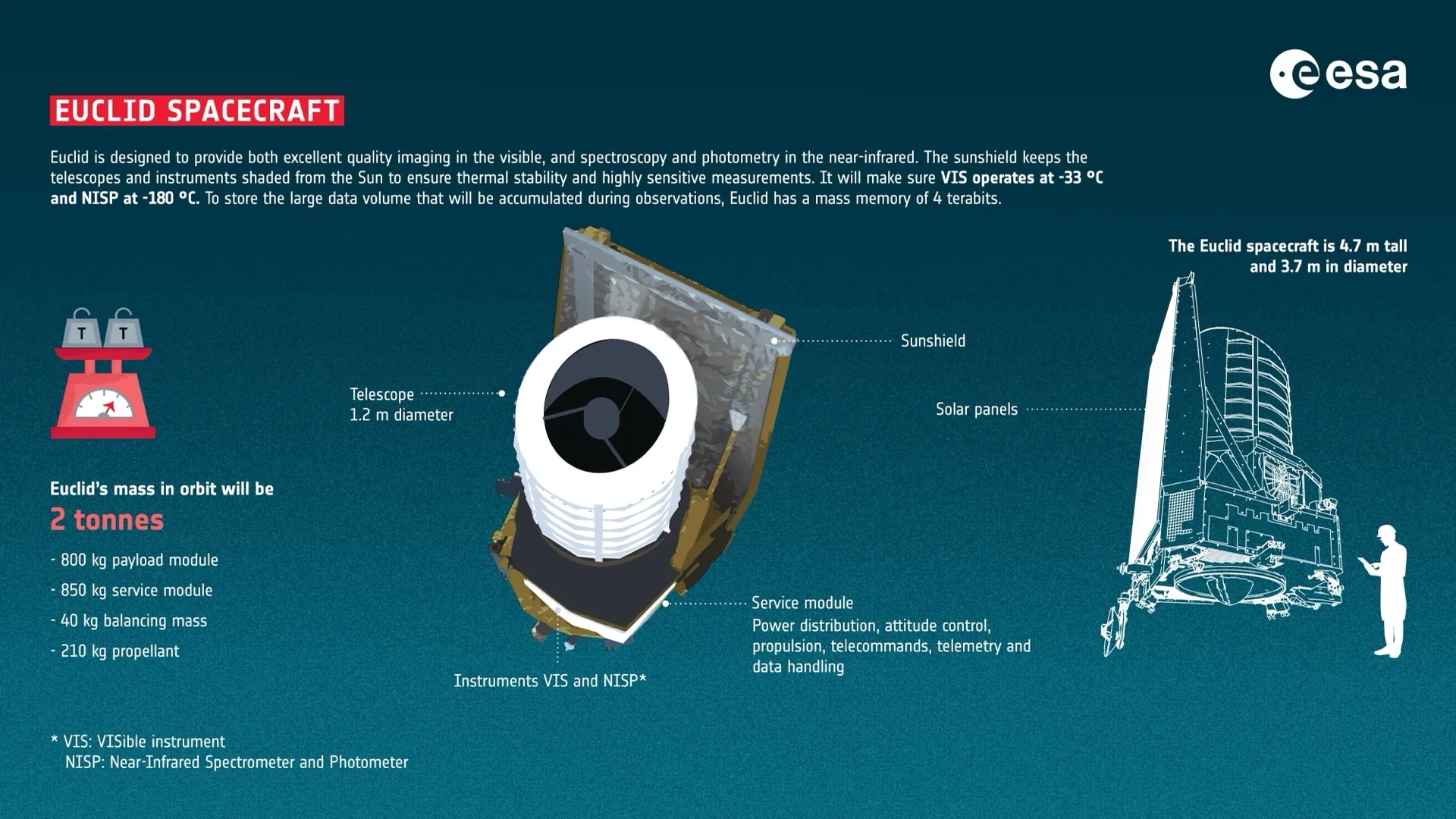
Launched on July 1, 2023, aboard a SpaceX Falcon 9 (a pragmatic choice while Ariane 6 was still in development), ESA's Euclid space telescope is one of the most ambitious cosmology missions ever conceived. Its goal is breathtaking in scope: to map the geometry of the dark universe by observing billions of galaxies across more than a third of the sky, looking back over 10 billion years of cosmic history.
Euclid carries two instruments -- a visible-light camera (VIS) and a near-infrared spectrometer and photometer (NISP) -- that work together to measure the shapes and redshifts of galaxies with extraordinary precision. By analyzing how the distribution of galaxies and their shapes have changed over time, scientists can infer the effects of dark energy and dark matter -- the two components that make up roughly 95% of the universe but that we still fundamentally do not understand.
The first images released from Euclid in late 2023 were stunning: razor-sharp views of galaxy clusters, globular clusters, and star-forming regions that showcased the telescope's optical quality. The science survey began in earnest in 2024, and over its six-year mission, Euclid will build a three-dimensional map of the universe that cosmologists will mine for decades.
For those of us who lie awake at night wondering what dark energy actually is, Euclid is one of the best chances we have of getting closer to an answer.
JUICE: Bound for Jupiter's Ocean Moons
ESA's Jupiter Icy Moons Explorer (JUICE) launched on April 14, 2023, beginning an eight-year cruise to the Jovian system. Its destination: the icy moons Ganymede, Europa, and Callisto, each suspected of harboring vast subsurface oceans beneath their frozen shells.
JUICE carries the most powerful remote sensing, geophysical, and in-situ instrument suite ever sent to the outer solar system. It will study the moons' surfaces, subsurface oceans, tenuous atmospheres, and their interactions with Jupiter's intense magnetosphere. The mission will culminate in 2034 when JUICE enters orbit around Ganymede -- becoming the first spacecraft ever to orbit a moon other than our own.
The question driving the mission is one that gives me chills every time I think about it: could these ocean worlds harbor conditions suitable for life? We are not necessarily talking about fish swimming under the ice. We are talking about the basic chemistry and energy sources that could support microbial life. If JUICE finds evidence of habitable environments around Jupiter, it would reshape our understanding of where life can exist in the universe.
During its cruise, JUICE has been conducting instrument checkouts and will perform gravity-assist flybys of Earth, Venus, and Earth again to gain the energy needed to reach Jupiter. The spacecraft is healthy, and the science team is already preparing for the encounter.
Hera: Checking Our Homework on Planetary Defense
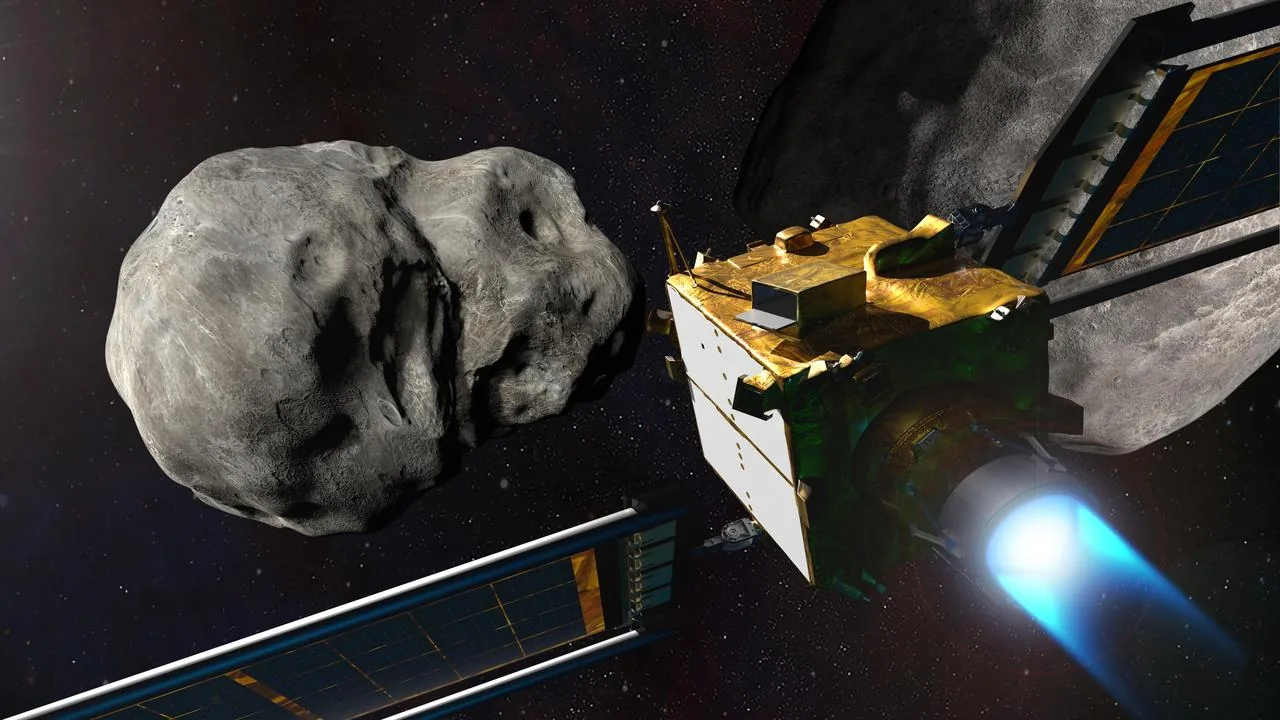
In October 2024, ESA launched the Hera mission toward the binary asteroid system Didymos and Dimorphos. If those names sound familiar, it is because NASA's DART spacecraft deliberately slammed into Dimorphos in September 2022, successfully altering the moonlet's orbit around its larger companion -- the first-ever demonstration of kinetic impactor planetary defense.
Hera's job is to go back and study the aftermath in detail. When it arrives in late 2026, Hera will conduct a close-up survey of Dimorphos to determine the exact mass and composition of the asteroid, the precise nature of the crater left by DART, and the efficiency of the momentum transfer. This data is essential because DART proved we can deflect an asteroid, but we need to understand how well we deflected it to build reliable planetary defense strategies for the future.
Hera also carries two CubeSats -- Milani and Juventas -- that will land on or near Dimorphos to study the surface and internal structure at close range, including using radar to peer inside the asteroid. The mission is a masterclass in international collaboration: NASA punched the asteroid, and ESA is going back to measure the bruise. Together, they are building humanity's first real toolkit for defending our planet against asteroid impacts.
This is the kind of mission that makes you proud to be a space enthusiast. It is practical, it is collaborative, and it addresses one of the few existential risks we can actually do something about.
Copernicus: Expanding Earth's Environmental Sentinel
ESA's Copernicus programme, operated in partnership with the European Union, continues to be one of the most important Earth observation systems in the world. The Sentinel satellite family provides free, open-access data used by thousands of organizations for climate monitoring, agricultural management, urban planning, disaster response, maritime surveillance, and atmospheric composition tracking.
The program is now expanding with the Copernicus Sentinel Expansion missions, designed to address emerging environmental monitoring needs. New missions in development include CHIME (Copernicus Hyperspectral Imaging Mission for the Environment), which will deliver detailed spectral data for agriculture, biodiversity, and soil management; CIMR (Copernicus Imaging Microwave Radiometer) for sea ice and sea surface temperature monitoring; CO2M for tracking anthropogenic carbon dioxide emissions from space; LSTM for land surface temperature monitoring; ROSE-L for high-resolution radar observations; and CRISTAL for polar ice and snow monitoring.
In a time when climate data has never been more critical, the expansion of Copernicus is one of the most consequential investments any space agency is making. The data is free. The tools are open. And the impact on policy, science, and lives is enormous.
Human Spaceflight and the ISS
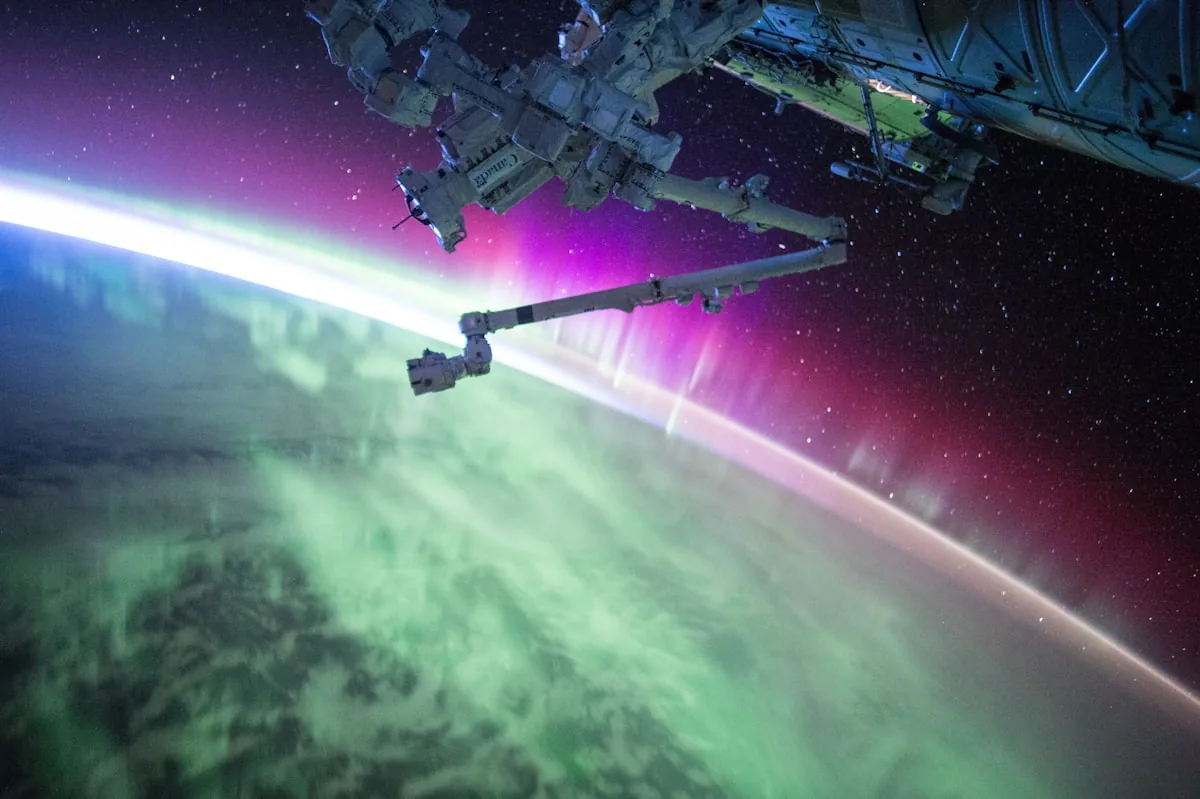
ESA continues to fly European astronauts to the International Space Station as part of its ongoing partnership with NASA and the other ISS partners. European astronauts bring unique scientific expertise and conduct experiments in ESA's Columbus laboratory module, advancing research in materials science, fluid physics, biology, and human physiology in microgravity.
Looking ahead, ESA is positioning itself as a key partner in future human exploration beyond low Earth orbit, contributing to the development of the Lunar Gateway -- the planned international outpost in lunar orbit that will support Artemis missions. ESA is building the ESPRIT refueling module and the I-HAB international habitation module for the Gateway, ensuring European presence and participation in the return to the Moon.
Looking Forward
ESA's roadmap for the coming years is packed. JUICE is on its way to Jupiter. Euclid is mapping the dark universe. Hera is heading to an asteroid. Ariane 6 is entering service. Copernicus is expanding. And European astronauts are preparing for missions to the Moon.
What ties all of this together is a conviction that space exploration is not optional. It is how we understand our universe, protect our planet, and inspire the next generation. ESA, with its unique model of cooperation among 22 member states, demonstrates that when nations pool their resources and talent, the results can be extraordinary.
The cosmos does not care about borders. Neither does great science. And ESA is proving that every day.